
Derivatives of Hyperbolic Sine and Cosine
Loading the math board and drawing, please wait…
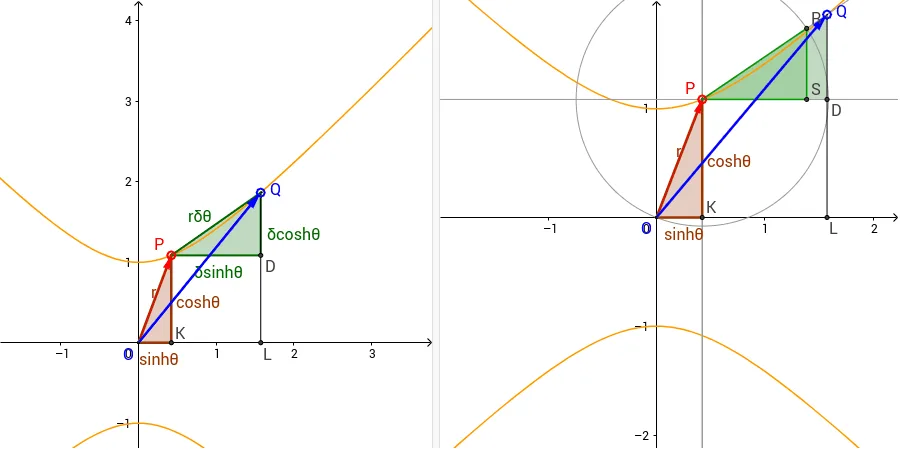
This example illustrates the derivatives of the hyperbolic sine and cosine functions. It involves core mathematical concepts such as derivatives, hyperbolic functions, and calculus. The construction utilizes GeoGebra commands and objects like Point, Vector, Polygon, Max, Circle, Ray, Intersect, Segment, Line, and Midpoint. It is suitable for high school and above students studying calculus to visually understand the derivative properties of hyperbolic functions.
GeoGebra Commands & Parameters
Point(o) → PVector(O, P) → OPPoint(o) → QVector(O, Q) → OP'Polygon(D, P, Q) → DPQ, DP, PQ, QDPolygon(O, K, P) → OKP, OK, KP, POMax(DP, QD) → dCircle(P, PO) → cPRay(P, Q) → tPIntersect(cP, tP) → R,Polygon(P, S, R) → PSR, PS, SR, RPSegment(L, Q) → LQLine(P, S) → xPLine(P, yAxis) → yPMidpoint(P, Q) → C
AI Drawing Prompt Reference
Draw the derivative graph of hyperbolic sine and cosine functions. Start by placing points P and Q at the origin, then draw vectors OP and OP'. Use P, Q, and O to create triangles DPQ and OKP. Find the maximum of DP and QD as d, and draw a circle cP with P as the center and d as the radius. Draw a ray tP from P to Q, and find its intersection R with circle cP. Create triangle PSR with P, S, and R. Draw line segment LQ from L to Q, and create lines xP and yP through P and S. Finally, find the midpoint C of P and Q.
The prompt above was compiled from the original drawing commands and is for reference only.