
Derivatives of Sine and Cosine
Loading the math board and drawing, please wait…
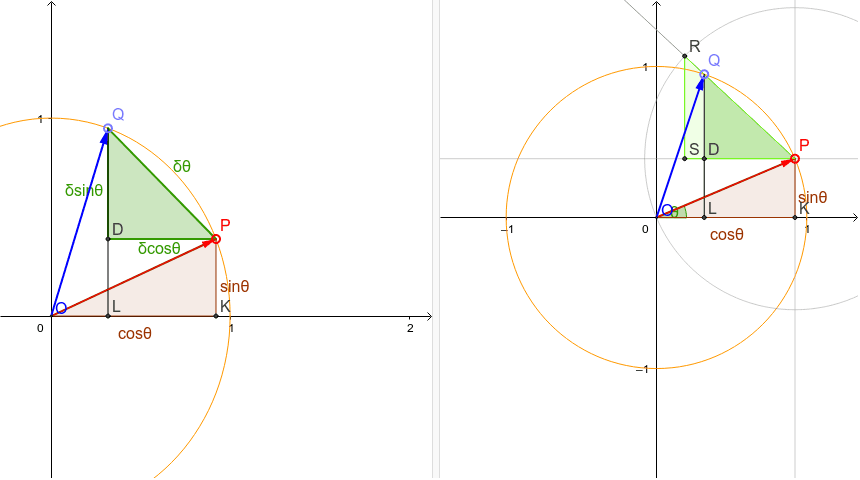
This example illustrates the derivatives of the sine and cosine functions. By dynamically adjusting the angle, one can observe the rate of change of these functions. Key mathematical concepts include derivatives and trigonometric functions. The construction uses commands such as Circle, Point, Vector, and Polygon in GeoGebra. Suitable for high school mathematics education and learning calculus concepts.
GeoGebra Commands & Parameters
Circle(O, 1) → oPoint(o) → PVector(O, P) → OPPoint(o) → QVector(O, Q) → OP'Polygon(D, P, Q) → DPQ, DP, PQ, QDPolygon(O, K, P) → OKP, OK, KP, POMax(DP, QD) → dCircle(P, 1) → cPRay(P, Q) → tPIntersect(cP, tP) → R,Polygon(P, S, R) → PSR, PS, SR, RPSegment(L, Q) → LQLine(P, S) → xPLine(P, yAxis) → yPAngle(K, O, P) → θAngle(D, Q, P) → θ'Angle(S, R, P) → θ''
AI Drawing Prompt Reference
Draw the graphs of the derivatives of sine and cosine functions. Start by drawing a unit circle, then take points P and Q on the circle and connect OP and OP', forming triangle DPQ. Next, draw a unit circle cP centered at P and find the intersection R of cP and the ray tP through PQ, forming triangle PSR. Finally, draw lines LQ, xP, and yP, and angles θ, θ', and θ''.
The prompt above was compiled from the original drawing commands and is for reference only.