
Geometric Demonstration of Complex Number Roots
Loading the math board and drawing, please wait…
In collections
Complex numbers
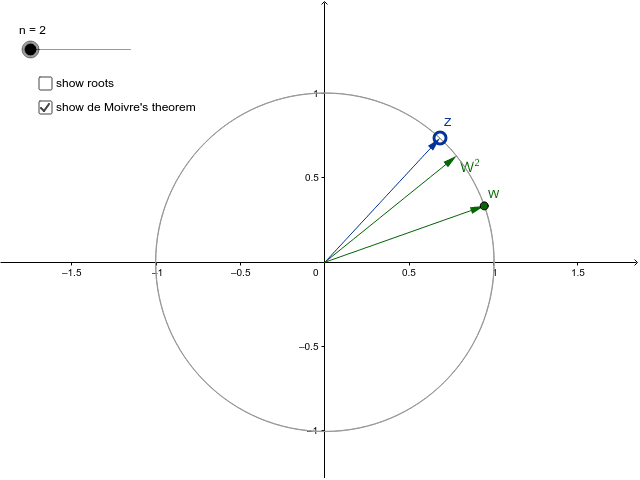
This example provides a geometrical illustration of finding the nth roots of a complex number, demonstrating De Moivre's theorem. It shows how to locate all n roots using polar coordinates of complex numbers. Key GeoGebra commands like Intersect, Sequence, Circle, Vector, and Point are used to construct the roots and their vector representations. Suitable for high school and above, helping students understand complex number operations and geometric interpretations.
GeoGebra Commands & Parameters
Intersect(xAxis, yAxis) → OSequence(Z^(1 / n) * exp(i * 2 * 3.141592653589793 * k / n), k, 0, n - 1) → RootsCircle(O, Z) → ZCircleVector(O, Z) → ZVectorCircle(O, abs(ZVector)^(1 / n)) → WCirclePoint(WCircle) → WSequence(Text["W^{" + (k) + "}", W^(k), n > 0, n > 0], k, 2, n) → WLabelsSequence(Vector[O, W^(k)], k, 1, n) → WVectorsSequence(Text["W_{" + (k) + "}", Element[Roots, k], n > 0, n > 0], k, 1, n) → RootsLabelsSequence(Vector[O, Element[Roots, k]], k, 1, n) → RootsVectorsSequence(Circle[O, abs(W^(k))], k, 2, n - 1) → WCircles
AI Drawing Prompt Reference
Draw a geometric illustration showing the nth roots of a complex number, centering on the origin with a circle representing the complex number and a vector showing it. Locate and draw all n roots using polar coordinates, represent each root with a vector, label each root and its corresponding vector, and use circles to show the modulus of each root.
The prompt above was compiled from the original drawing commands and is for reference only.