
Demonstrating the Volume of Pyramids
Loading the math board and drawing, please wait…
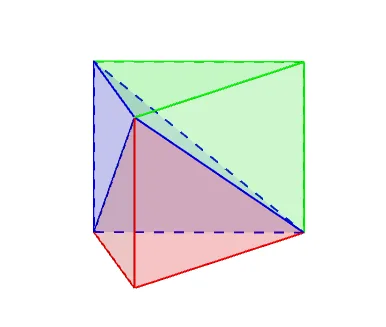
This example dynamically demonstrates the formula for the volume of a pyramid, showing that it equals one third of the base area times the height. It involves core mathematical concepts like volume calculation, geometric body construction, and proportional relationships. GeoGebra commands and objects used include If, Translate, Intersect, Pyramid, Dilate, Polygon, etc., such as translating points and constructing pyramids. It is suitable for high school solid geometry instruction, helping students visually understand the derivation of the volume formula.
GeoGebra Commands & Parameters
If(s ≤ 0, (-s), 0) → s2If(s ≥ 0, s, 0) → s1Translate(C, Vector[B, D]) → C'Intersect(OrthogonalPlane[B, Segment[A, C]], Line[A, C]) → GTranslate(A, Vector[B, D]) → A'Intersect(OrthogonalPlane[B, Segment[A, C]], Line[A', C']) → HIntersect(OrthogonalPlane[C, Segment[A, B]], Line[A', D]) → FIntersect(OrthogonalPlane[C, Segment[A, B]], Line[A, B]) → ETranslate(Rotate[Translate[Rotate[C, (α * s1), Segment[A, B]], Vector[(s1 * Vector[(0, 0, 0), (0, z(D), 0)])]], ((-β) * s2), Segment[A, C]], Vector[(s2 / 2 * Vector[(0, 0, 0), (z(D), 0, 0)])]) → LTranslate(Rotate[Translate[Rotate[Polygon[A, D, A'], (α * s1), Segment[A, B]], Vector[(s1 * Vector[(0, 0, 0), (0, z(D), 0)])]], ((-β) * s2), Segment[A, C]], Vector[(s2 / 2 * Vector[(0, 0, 0), (z(D), 0, 0)])]) → poly2Pyramid(Polygon[A, B, C], D) → a, faceABD, faceBCD, faceACD_1, edgeAD, edgeBD, edgeCD_1Translate(Rotate[Translate[Rotate[D, (α * s1), Segment[A, B]], Vector[(s1 * Vector[(0, 0, 0), (0, z(D), 0)])]], ((-β) * s2), Segment[A, C]], Vector[(s2 / 2 * Vector[(0, 0, 0), (z(D), 0, 0)])]) → KTranslate(Rotate[Translate[Rotate[Polygon[A, C, A'], (α * s1), Segment[A, B]], Vector[(s1 * Vector[(0, 0, 0), (0, z(D), 0)])]], ((-β) * s2), Segment[A, C]], Vector[(s2 / 2 * Vector[(0, 0, 0), (z(D), 0, 0)])]) → poly3Pyramid(Polygon[A', D, C'], C) → b, faceA'CD_1, faceCC'D, faceA'CC', edgeA'C_1, edgeCD_2, edgeCC'Translate(Translate[Rotate[a, (α * s1), Segment[A, B]], Vector[(s1 * Vector[(0, 0, 0), (0, z(D), 0)])]], Vector[(o2 * Vector[A, B])]) → a'Pyramid(Polygon[A, D, A'], C) → c, faceACD, faceA'CD, faceAA'C, edgeAC, edgeCD, edgeA'CTranslate(Rotate[c, (α * s1), Segment[A, B]], Vector[(s1 * Vector[(0, 0, 0), (0, z(D), 0)])]) → c'Translate(Rotate[Translate[b, Vector[(o1 * Vector[A, C])]], (s1 * α), Segment[A, B]], Vector[(s1 * Vector[(0, 0, 0), (0, z(D), 0)])]) → b'Translate(Rotate[a', ((-β) * s2), Segment[A, C]], Vector[(s2 / 2 * Vector[(0, 0, 0), (z(D), 0, 0)])]) → a''Translate(Rotate[b', ((-β) * s2), Segment[A, C]], Vector[(s2 / 2 * Vector[(0, 0, 0), (z(D), 0, 0)])]) → b''Translate(Rotate[c', ((-β) * s2), Segment[A, C]], Vector[(s2 / 2 * Vector[(0, 0, 0), (z(D), 0, 0)])]) → c''Translate(Rotate[Translate[Translate[Rotate[Polygon[A, B, D], (α * s1), Segment[A, B]], Vector[(s1 * Vector[(0, 0, 0), (0, z(D), 0)])]], Vector[(o2 * Vector[A, B])]], ((-β) * s2), Segment[A, C]], Vector[(s2 / 2 * Vector[(0, 0, 0), (z(D), 0, 0)])]) → poly1Translate(Rotate[Translate[Translate[Rotate[C, (α * s1), Segment[A, B]], Vector[(s1 * Vector[(0, 0, 0), (0, z(D), 0)])]], Vector[(o2 * Vector[A, B])]], ((-β) * s2), Segment[A, C]], Vector[(s2 / 2 * Vector[(0, 0, 0), (z(D), 0, 0)])]) → IDilate(poly2, 1 - h, L) → poly2'Dilate(poly1, 1 - h, I) → poly1'Translate(Rotate[Translate[Rotate[Translate[Polygon[A', C, C'], Vector[(o1 * Vector[A, C])]], (s1 * α), Segment[A, B]], Vector[(s1 * Vector[(0, 0, 0), (0, z(D), 0)])]], ((-β) * s2), Segment[A, C]], Vector[(s2 / 2 * Vector[(0, 0, 0), (z(D), 0, 0)])]) → poly4Translate(Rotate[Translate[Rotate[Translate[D, Vector[(o1 * Vector[A, C])]], (s1 * α), Segment[A, B]], Vector[(s1 * Vector[(0, 0, 0), (0, z(D), 0)])]], ((-β) * s2), Segment[A, C]], Vector[(s2 / 2 * Vector[(0, 0, 0), (z(D), 0, 0)])]) → JDilate(poly3, 1 - h, K) → poly3'Dilate(poly4, 1 - h, J) → poly4'Polygon((-6, -6), (6, -6), (6, 6), (-6, 6)) → poly5, d, e, f, g