
Dadras Attractor
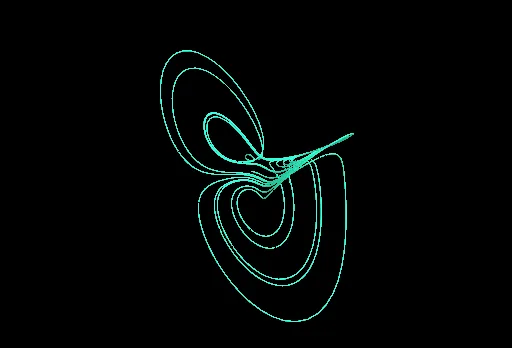
Loading the math board and drawing, please wait…
The Dadras attractor is a typical example of a chaotic dynamical system, showcasing complex dynamic behavior in three-dimensional space. This example involves solving ordinary differential equations using calculus and calculating the length of three-dimensional vectors. By utilizing GeoGebra commands such as NSolveODE, Length, Sequence, and PolyLine, the formation process of the attractor can be dynamically observed. Suitable for high school and above students and teachers to understand chaos theory and dynamical systems.
GeoGebra Commands & Parameters
LaTeX(x', true, true) → text1LaTeX(y', true, true) → text2LaTeX(z', true, true) → text3NSolveODE({x', y', z'}, 0, {x0, y0, z0}, 40) → numericalIntegral1, numericalIntegral2, numericalIntegral3Length(numericalIntegral1) → lenSequence((y(Point[numericalIntegral1, i]), y(Point[numericalIntegral2, i]), y(Point[numericalIntegral3, i])), i, 0, 1, 1 / len) → L_1PolyLine(L_1) → fIf(len ≟ len, 0, 1) → val