
Curry's Paradox 3!
Loading the math board and drawing, please wait…
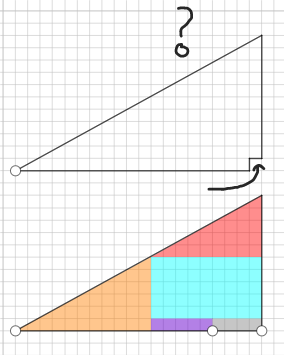
Curry's Paradox 3! demonstrates geometric probability and graphical construction. It involves constructing polygons, circles, and triangles to illustrate the relationship between geometry and probability. Key mathematical concepts include geometric construction, probability statistics, and coordinate geometry. The construction uses GeoGebra commands such as Polygon, Segment, Circle, Point, Line, OrthogonalLine, and Intersect. This example is suitable for high school students or college students learning the integration of geometry and probability.
GeoGebra Commands & Parameters
Polygon(A, C, D) → t1, d, a, cPolygon(B, E, F) → t2, f_1, b, eSegment(K, L) → hSegment(M, L) → iSegment(M, K) → jSegment(J, H) → mCircle(N, 9) → pPoint(p) → OLine(N, O) → nOrthogonalLine(O, n) → qCircle(O, 5) → rIntersect(r, q, 2) → POrthogonalLine(P, q) → sOrthogonalLine(N, n) → tIntersect(s, t) → QPolygon(N, O, P, Q) → q1, n_1, o, p_1, q_1Circle(R, 5) → c_1Point(c_1) → SLine(R, S) → g_1OrthogonalLine(S, g_1) → h_1Circle(S, 1) → d_1Intersect(d_1, h_1, 2) → TOrthogonalLine(T, h_1) → i_1OrthogonalLine(R, g_1) → j_1Intersect(i_1, j_1) → UPolygon(R, S, T, U) → q2, r_1, s_1, t_1, uCircle(V, 4) → e_1Point(e_1) → WLine(V, W) → k_1OrthogonalLine(W, k_1) → l_1Circle(W, 1) → c_2Intersect(c_2, l_1, 2) → ZOrthogonalLine(Z, l_1) → m_1OrthogonalLine(V, k_1) → a_1Intersect(m_1, a_1) → A_1Polygon(V, W, Z, A_1) → q3, v, w, z_1, b_1Segment(J, D_1) → kSegment(D_1, C_1) → lSegment(C_1, B_1) → f_2Segment(B_1, H) → g_2
AI Drawing Prompt Reference
Draw a geometric figure with multiple polygons and circles. Start by constructing two triangles, then draw three line segments connecting certain points. Next, draw a large circle centered at a point, pick a point on the circle, draw a perpendicular line through that point to the diameter, then draw a smaller circle centered at that point, intersecting the perpendicular line. From the intersection, draw another perpendicular to the perpendicular line, and intersect it with the perpendicular through the center, forming a quadrilateral. Repeat similar steps to construct two more similar quadrilaterals, each with a circle and perpendicular structure. Finally, draw four line segments connecting outer points to complete the figure.
The prompt above was compiled from the original drawing commands and is for reference only.