
Cuboid and Yangma
Loading the math board and drawing, please wait…
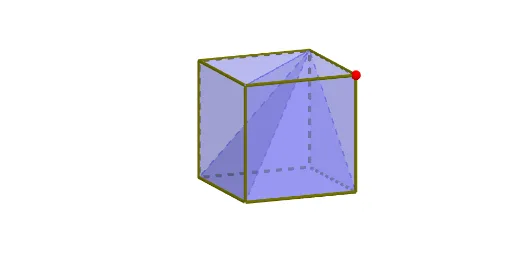
This example demonstrates the geometric construction of a cuboid and a yangma, a special type of tetrahedron with a square base. Using GeoGebra commands such as PointIn, If, Rotate, and Translate, the volume calculation process of the yangma can be dynamically demonstrated. This example is suitable for high school mathematics education, particularly for teaching solid geometry and volume calculations.
GeoGebra Commands & Parameters
PointIn(Polygon[(2, 2, 4), (3, 2, 4), (3, 3, 4), (2, 3, 4)]) → PIf(t' < 1, t', 1) → t1If(t' > 1, t' - 1, 0) → t2Rotate(Midpoint[P, D], ((t1 * 90))°, Segment[D, A]) → ETranslate(Rotate[Rotate[Pyramid[Polygon[P, S, D, A], Q], ((t1 * 90))°, Segment[D, A]], ((t2 * 90))°, Segment[E, E + (0, 0, 1)]], Vector[(t2 * Vector[(abs(z(P) / 2 - y(P)), 0, 0)])]) → bTranslate(Pyramid[Polygon[B, C, D, A], Q], Vector[(0, 0)]) → cRotate(Midpoint[R, D], ((t1 * 90))°, Segment[C, D]) → FTranslate(Rotate[Rotate[Pyramid[Polygon[R, C, D, S], Q], ((t1 * 90))°, Segment[C, D]], ((t2 * (-90)))°, Segment[F, F + (0, 0, 1)]], Vector[(t2 * Vector[(0, (-abs(x(P) - z(P) / 2)), 0)])]) → dTranslate(Prism[Polygon[(x(P), y(P), 0), ((-x(P)), y(P), 0), ((-x(P)), (-y(P)), 0), (x(P), (-y(P)), 0)], P], Vector[(0, 0)]) → a
AI Drawing Prompt Reference
Draw a cuboid and a yangma. Start by creating a cuboid with a square base, then construct a yangma at one of the cuboid's vertices, with its base coinciding with the cuboid's base and its height equal to the cuboid's height. Use rotation and translation to dynamically demonstrate the volume calculation of the yangma.
The prompt above was compiled from the original drawing commands and is for reference only.