
Cube Volume as Sum of Three Inscribed Pyramids
Loading the math board and drawing, please wait…
In collections
Dissecting a cube into equal parts
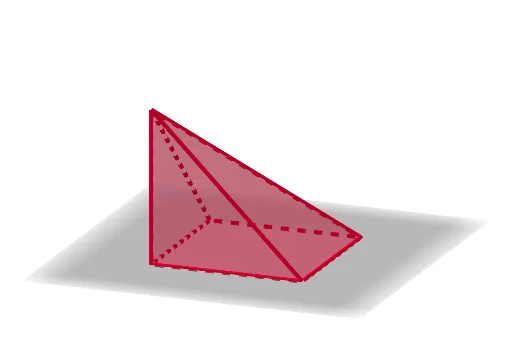
This GeoGebra example dynamically demonstrates that the volume of a cube can be decomposed into the sum of the volumes of three congruent pyramids inscribed within it. The core mathematical concepts involve solid geometry, volume decomposition, and the pyramid volume formula, along with spatial transformations such as translation and rotation. The construction uses commands like Sequence, Polygon, Vector, Pyramid, Translate, Rotate, and Line to build the cube and its internal pyramids. Sliders (sl) control the animation, and text objects (texto1, texto2) display the volume relationship. This is suitable for high school or early college students to visualize the geometric derivation of volume formulas, and serves as an intuitive teaching aid for solid geometry.
GeoGebra Commands & Parameters
Sequence(Max[0, Min[1, t - s]], s, 0, 5) → slPolygon(A, B, 4) → pol1, f, g, h, i, C, DVector(C, B) → uPyramid(pol1, E) → pira1, caraABE, caraBCE, caraCDE, caraADE, aristaAE, aristaBE, aristaCE, aristaDETranslate(pira1, Vector[(sl(1) * u)]) → pira2Translate((0, 0, 0), u) → FRotate(pira2, (sl(2) * ((-π)) / 2), F) → pira2'Line(A, B) → jRotate(pira2', (sl(3) * ((-π)) / 2), j) → pira2''Vector(C, D) → vTranslate(pira1, Vector[(sl(4) * v)]) → pira3Translate((0, 0, 0), v) → GRotate(pira3, (π / 2 * sl(5)), G) → pira3'Line(A, D) → kRotate(pira3', (π / 2 * sl(6)), k) → pira3''