
3D Dynamic Demo of a Pyramid’s Volume using Prism/Pyramid and Rotation
Loading the math board and drawing, please wait…
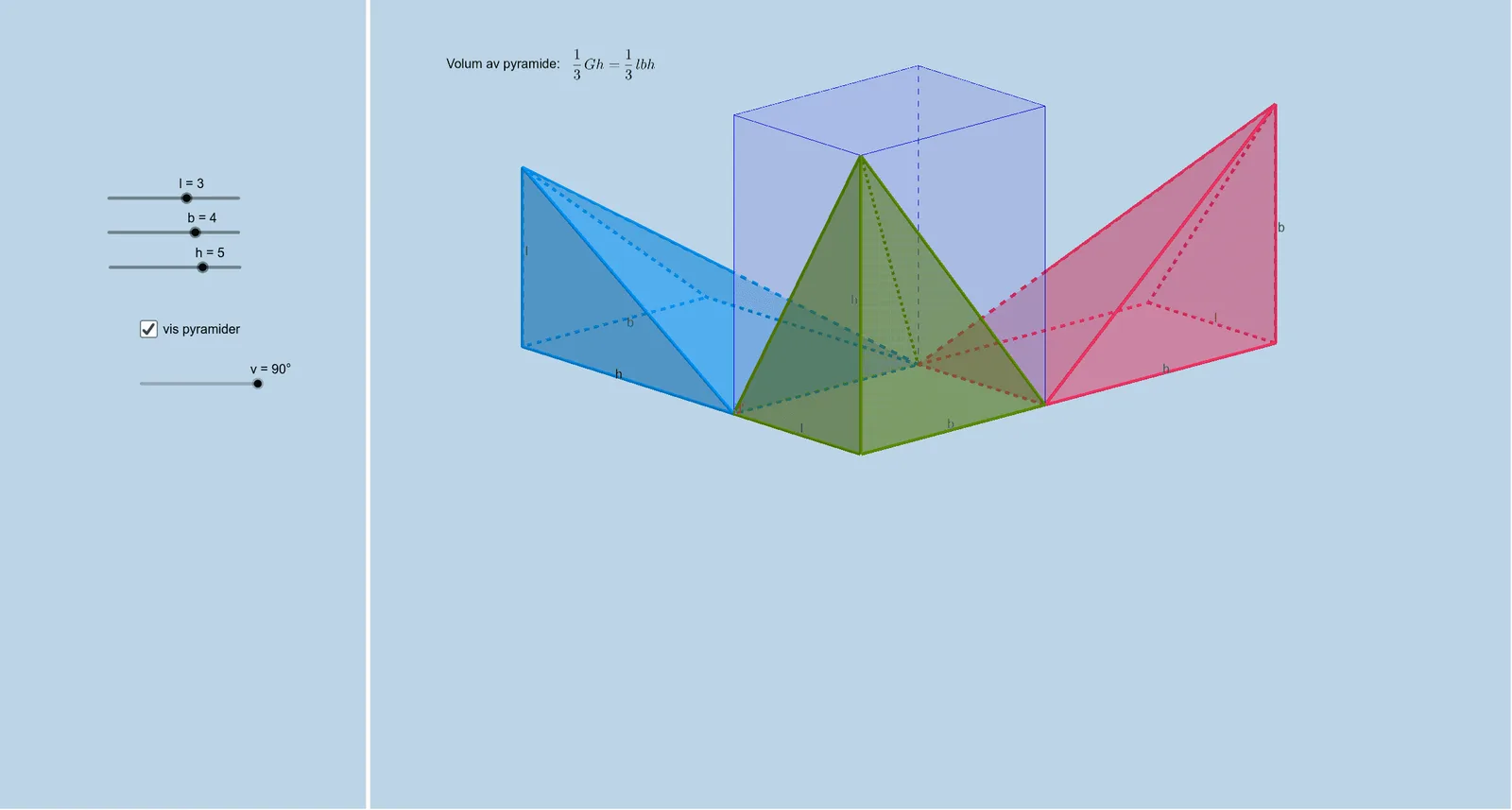
This example provides a 3D dynamic visualization of the volume of a pyramid as its geometric parameters change. Key math concepts include solid geometry volume, the structural decomposition of polyhedra, and representing a pyramid via polygonal faces and edges to build spatial intuition. Construction-wise, it is based on GeoGebra commands Prism, Pyramid, Line, and Rotate. Points/parameters such as A, B, C, D, E, F, G, H and quantities like the height h define the base and apex structure; then multiple face objects (e.g., faceABCD, faceABF, faceBCGF, faceCDHG1, faceADHE1, faceEFGH) and edge objects (e.g., edgeAB, edgeBC, edgeCD2, edgeAD2) are created to form the full 3D polyhedron. Rotate drives the dynamic 3D effect, helping learners understand how the spatial construction relates to volume. Suitable for upper secondary to early university use, for classroom exploration, modeling practice, and interactive geometry learning.
GeoGebra Commands & Parameters
Prism(A, B, C, D, E) → a, F, edgeAB_{1}, edgeBC_{1}, edgeCD_{1}, edgeAD_{1}, edgeAE_{1}, edgeBF_{1}, edgeCG_{1}, edgeDH_{1}, edgeEF_{1}, edgeFG_{1}, G, edgeGH_{1}, edgeEH_{1}, H, faceABCD_{1}, faceABFE, faceBCGF, faceCDHG_{1}, faceADHE_{1}, faceEFGHPyramid(A, B, C, D, F) → c, faceABCD, edgeAF_{1}, edgeBF, edgeCF_{1}, edgeDF_{1}, faceABF, faceBCF, faceCDF_{1}, faceADF_{1}, edgeAB, edgeBC, edgeCD_{2}, edgeAD_{2}Line(A, B) → fPyramid(C, D, H, G, F) → d, faceCDHG, edgeCF, edgeDF_{2}, edgeFH_{1}, edgeFG, faceCDF, faceDFH_{1}, faceFGH, faceCFG, edgeCD, edgeDH_{2}, edgeGH, edgeCGLine(D, C) → gRotate(d, (-v), g) → d'Pyramid(A, D, H, E, F) → i, faceADHE, edgeAF, edgeDF, edgeFH, edgeEF, faceADF, faceDFH, faceEFH, faceAEF, edgeAD, edgeDH, edgeEH, edgeAELine(A, D) → jRotate(i, (-v), j) → i'Rotate(HB, (-v), j) → HH'Rotate(BB, (-v), j) → BB'Rotate(LB, (-v), j) → LB'Rotate(LR, (-v), g) → LR'Rotate(BR, (-v), g) → BR'Rotate(HR, (-v), g) → HR'
AI Drawing Prompt Reference
Create a 3D dynamic demonstration of a pyramid's volume. Start with a rectangular prism as a reference solid, with its base as a rectangle and top vertices corresponding to the bottom ones. Then, construct a pyramid using the four base vertices and one apex vertex located on an edge of the prism's top face. Rotate some side faces of the pyramid around their base edges to create a dynamic unfolding effect, while keeping the full pyramid structure visible. Clearly show all triangular faces, the base quadrilateral, and edges, with a height parameter indicated. The overall scene is a 3D solid geometry model with rotation animation.
The prompt above was compiled from the original drawing commands and is for reference only.