
Crossing Chords Property & Proof (II)
Loading the math board and drawing, please wait…
In collections
Circles (Theorems)
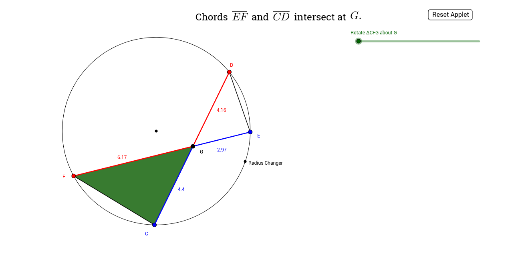
This example demonstrates the crossing chords property and its proof (II). Key mathematical concepts include circle properties and geometric proofs. Using GeoGebra commands such as Circle, Point, Segment, Intersect, Polygon, Angle, Rotate, Mirror, Line, Dilate, Distance, the intersection of chords is constructed. Suitable for middle school and above students to learn geometric proofs and circle properties.
GeoGebra Commands & Parameters
Circle(A, B) → cPoint(c) → CPoint(c) → DPoint(c) → EPoint(c) → FSegment(C, D) → aSegment(F, E) → bIntersect(a, b) → GSegment(F, G) → dSegment(G, E) → eSegment(C, G) → fSegment(G, D) → gCircle(A_1, B_1) → c_1Point(c_1) → C_1Point(c_1) → D_1Point(c_1) → E_1Point(c_1) → F_1Segment(C_1, D_1) → a_1Segment(F_1, E_1) → b_1Intersect(a_1, b_1) → G_1Segment(F_1, G_1) → d_1Segment(G_1, E_1) → e_1Segment(C_1, G_1) → f_1Segment(G_1, D_1) → g_1Segment(D, E) → kSegment(F, C) → lPolygon(G, E, D) → poly1, d_2, g_2, e_2Polygon(G, F, C) → poly2, c_2, g_3, f_2Angle(D, G, F) → αRotate(G, If[0 ≤ m < 1, (-((m * α))), (-α)], G) → G'Rotate(F, If[0 ≤ m < 1, (-((m * α))), (-α)], G) → F'Rotate(C, If[0 ≤ m < 1, (-((m * α))), (-α)], G) → C'Polygon(G', F', C') → poly2', c', g', f'Mirror(G', g) → G''Mirror(F', g) → F''Mirror(C', g) → C''Polygon(G'', F'', C'') → poly2'', c'', g'', f''Line(D, C) → pDilate(G'', If[0 < o ≤ 1, ((o - 1) * q), q], G) → G'''Dilate(F'', If[0 < o ≤ 1, 1 - o, 0], D) → F'''Dilate(C'', If[0 < o ≤ 1, 1 - o, 0], E) → C'''Polygon(G, C''', F''') → poly3, f''', g_4, c'''Angle(F, G, C) → βDistance(G, C''') → sDistance(G, F''') → tDistance(G, C''') → uDistance(G, F''') → vDistance(G, F) → wDistance(G, C) → i_1
AI Drawing Prompt Reference
Draw a circle and place several points inside it. Connect these points to form two intersecting chords, marking their intersection point. Construct two symmetric triangles using the chords and the intersection point. Rotate one of the triangles around the intersection point, then mirror the rotated triangle's vertices to create new triangles. Finally, connect the original and mirrored triangles to form a new geometric shape, measuring relevant distances and angles.
The prompt above was compiled from the original drawing commands and is for reference only.