
Coordinate Geometry Proof: Diagonals of a Parallelogram Bisect Each Other
Loading the math board and drawing, please wait…
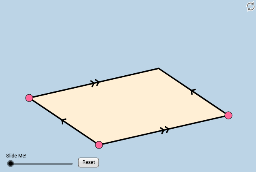
This GeoGebra example demonstrates and proves the classic theorem that the diagonals of a parallelogram bisect each other, using a coordinate geometry approach. It constructs a dynamic parallelogram and marks the intersection of its diagonals, then verifies via midpoint calculations that this point is the midpoint of both diagonals. Core mathematical concepts include parallelogram properties, midpoint formula, vector translation, and deductive proof in analytic geometry. The construction uses GeoGebra commands such as Line, Segment, Midpoint, Vector, Translate, and Polygon, along with auxiliary points and an interactive button for dynamic manipulation. This resource is suitable for upper middle school or high school students learning coordinate geometry and geometric proofs, and serves as an effective visual aid for teachers to illustrate the connection between algebraic computation and geometric reasoning.
GeoGebra Commands & Parameters
Line(A, B) → aSlope(a) → mPointIn(c) → CLine(C, a) → eVector(A, B) → uTranslate(C, u) → C'Segment(B, C') → fSegment(C, C') → gSegment(A, B) → hSegment(A, C) → dMidpoint(A, C') → DDilate(A, If[0 < k ≤ 1, 1 - k, 0], D) → A'Segment(A, A') → iDilate(D, If[1 < k ≤ 2, 2 - k, 0], C') → D'Segment(D, D') → lDilate(C, If[2 < k ≤ 3, 3 - k, 0], D) → C'_1Segment(C, C'_1) → jDilate(D, If[3 < k ≤ 4, 4 - k, 0], B) → D'_1Segment(D, D'_1) → nRotate(D, If[5 < k ≤ 6, ((k - 5) * π), 3.141592653589793], D) → D'_2Rotate(D', If[4 < k ≤ 5, ((k - 4) * π), 3.141592653589793], D) → D''Segment(D'_2, D'') → l'Rotate(D, If[6 < k ≤ 7, ((k - 6) * π), 3.141592653589793], D) → D'_3Rotate(D'_1, If[5 < k ≤ 6, ((k - 5) * π), 3.141592653589793], D) → ESegment(D'_3, E) → n'Rotate(A, If[6 < k ≤ 7, ((-(k - 6)) * π), -3.141592653589793], D) → A'_1Rotate(B, If[6 < k ≤ 7, ((-(k - 6)) * π), -3.141592653589793], D) → B'Polygon(A, B, C', C) → poly1, a_1, b_1, c', c_1