
Double Glide Reflection Tessellation
Loading the math board and drawing, please wait…
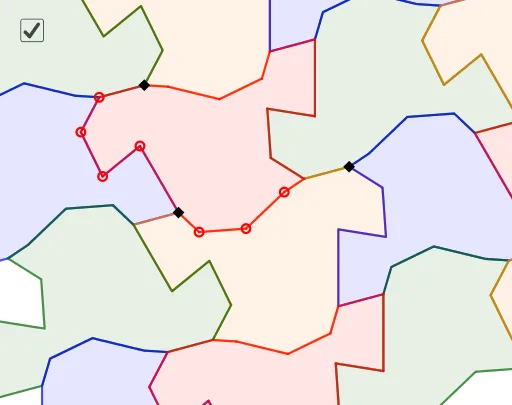
This example demonstrates a double glide reflection tessellation. It involves the concepts of reflection and glide reflection transformations. Using GeoGebra commands such as Vector, Point, LineBisector, Line, Translate, and Polygon, a specific symmetric tiling pattern can be constructed. Suitable for middle school and above students to learn about geometric transformations and tiling patterns.
GeoGebra Commands & Parameters
Vector(A, B) → uPoint(Ray[A, A - OrthogonalVector[u]]) → CVector(A, C) → vLineBisector(A, B) → fLineBisector(A, C) → gLine(B, f) → hPoint(h) → JTranslate(Mirror[J, f], v) → KTranslate(Mirror[D, f], v) → LTranslate(Mirror[E, f], v) → MTranslate(Mirror[F, f], v) → NTranslate(Mirror[A, f], v) → OVector(A, J) → wTranslate(Mirror[G, g], w) → PTranslate(Mirror[A, g], w) → QTranslate(Mirror[H, g], w) → RTranslate(Mirror[I, g], w) → SPolygon(B, J, L, M, N, O, Q, P, R, S, D, E, F, A, G, H, I, K) → poly1, i, s, t, a, b, c, d, e, f_1, g_1, j, k, l, m, n, p, q, rTranslate(Polygon[Mirror[B, g], Mirror[J, g], Mirror[D, g], Mirror[E, g], Mirror[F, g], Mirror[A, g], Mirror[G, g], Mirror[H, g], Mirror[I, g], Mirror[K, g], Mirror[L, g], Mirror[M, g], Mirror[N, g], Mirror[O, g], Mirror[Q, g], Mirror[P, g], Mirror[R, g], Mirror[S, g]], w) → poly2Translate(Polygon[Mirror[B, f], Mirror[J, f], Mirror[D, f], Mirror[E, f], Mirror[F, f], Mirror[A, f], Mirror[G, f], Mirror[H, f], Mirror[I, f], Mirror[K, f], Mirror[L, f], Mirror[M, f], Mirror[N, f], Mirror[O, f], Mirror[Q, f], Mirror[P, f], Mirror[R, f], Mirror[S, f]], v) → poly3Translate(Mirror[poly3, g], w) → poly4Translate(poly4, Vector[(2 * v)]) → poly4'Translate(poly3, Vector[(-2 * v)]) → poly3'Translate(poly2, Vector[(-2 * u)]) → poly2'Translate(poly4', Vector[(-2 * u)]) → poly4''Translate(poly4, Vector[(-2 * u)]) → poly4'_1Translate(poly3', Vector[(-2 * u)]) → poly3''Polygon(Translate[B, Vector[(-2 * u)]], Translate[J, Vector[(-2 * u)]], Translate[L, Vector[(-2 * u)]], Translate[M, Vector[(-2 * u)]], Translate[N, Vector[(-2 * u)]], Translate[O, Vector[(-2 * u)]], Translate[Q, Vector[(-2 * u)]], Translate[P, Vector[(-2 * u)]], Translate[R, Vector[(-2 * u)]], Translate[S, Vector[(-2 * u)]], Translate[D, Vector[(-2 * u)]], Translate[E, Vector[(-2 * u)]], Translate[F, Vector[(-2 * u)]], Translate[A, Vector[(-2 * u)]], Translate[G, Vector[(-2 * u)]], Translate[H, Vector[(-2 * u)]], Translate[I, Vector[(-2 * u)]], Translate[K, Vector[(-2 * u)]]) → poly5, h_1, r_1, s_1, t_1, a_1, b_1, c_1, d_1, e_1, f_2, i_1, j_1, k_1, l_1, m_1, n_1, p_1, q_1Translate(poly3'', Vector[(2 * v)]) → poly3'''Translate(poly5, Vector[(2 * v)]) → poly5'Translate(poly2', Vector[(2 * v)]) → poly2''Translate(poly2, Vector[(2 * v)]) → poly2'_1Translate(poly5', Vector[(2 * u)]) → poly5''
AI Drawing Prompt Reference
Create a symmetric tessellation generated by double glide reflections. Start with two non-parallel vectors defining translation directions. Construct a base polygon, then reflect it across one perpendicular bisector and translate along the second vector to form one copy set. Reflect across another perpendicular bisector and translate along the first vector for another set. Repeat translations of these sets in both positive and negative directions along both vectors to tile the plane, producing a periodic interlocking pattern of polygons.
The prompt above was compiled from the original drawing commands and is for reference only.