
Construction of Regular 3-, 4-, and 6-Sided Polygons
Loading the math board and drawing, please wait…
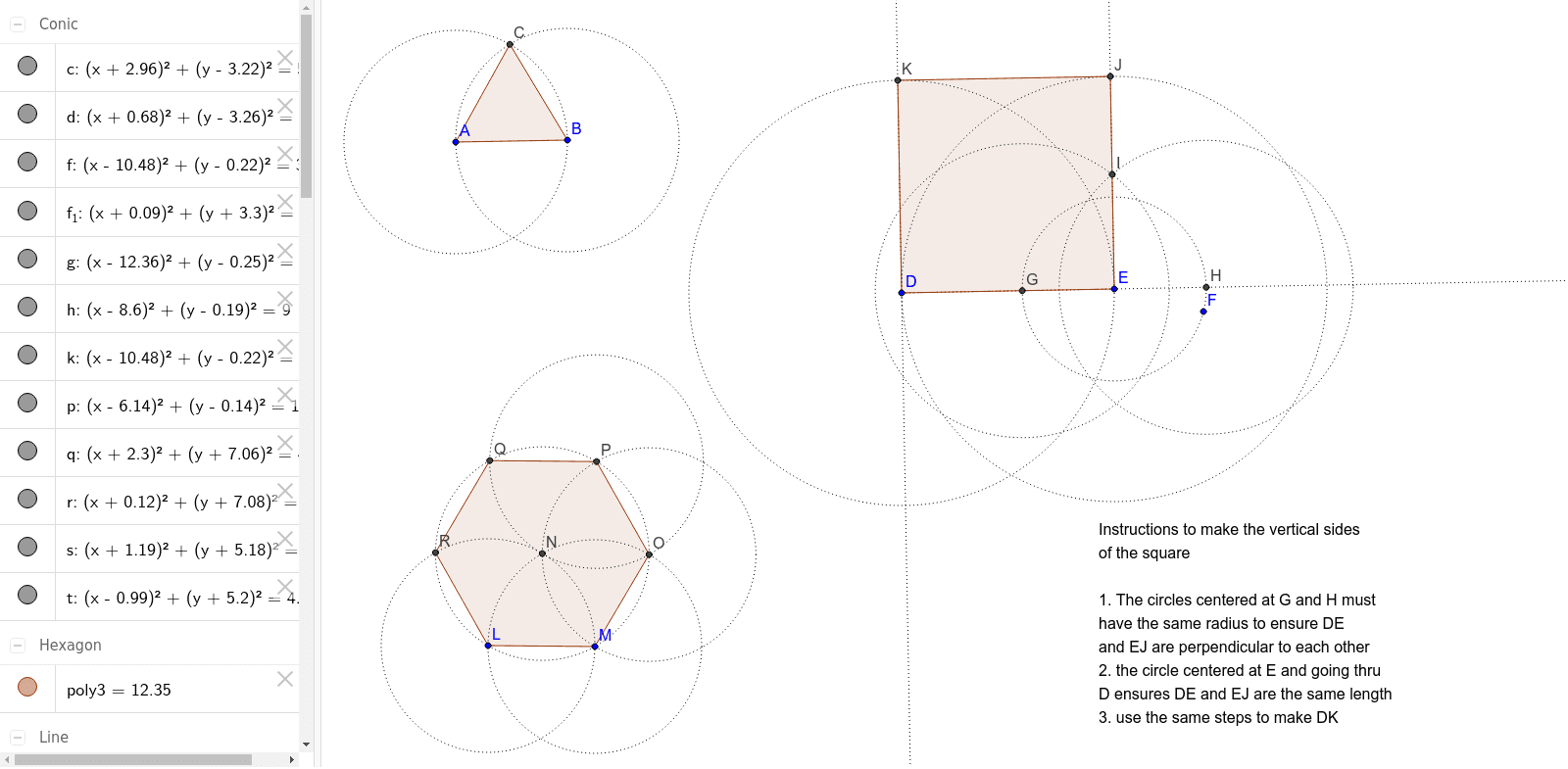
①This GeoGebra example demonstrates how to construct regular triangles, squares, and hexagons using basic geometric construction tools such as circles, rays, and perpendicular lines. ②The core mathematical concepts involve the classical ruler-and-compass construction of regular polygons, the relationship between central angles and side lengths, and the properties of circumcircles and interior angles. ③From the construction summary, the commands used include Circle, Intersect, Polygon, Ray, and OrthogonalLine, with numerous objects like points (A, B, C, D, E, F, G, H, I, J, K, L, M, N, O, P), lines (a, b, c, d, e, f, g, h, i, j, k, p, q, r, s, t), circles (c, c_1, d_1, e_1, j_1, k_1), and polygons (poly1, poly2), indicating a step-by-step construction process. ④This resource is suitable for middle and high school students learning geometric constructions and properties of regular polygons, as well as for teachers demonstrating dynamic construction in the classroom to enhance understanding of the underlying mathematical principles.
GeoGebra Commands & Parameters
Circle(A, B) → cCircle(B, A) → dIntersect(c, d, 1) → CPolygon(C, B, A) → poly1, a, c_1, bRay(D, E) → eCircle(E, F) → fIntersect(f, e, 1) → GIntersect(f, e, 2) → HCircle(H, 3) → gCircle(G, 3) → hIntersect(g, h, 2) → ICircle(E, D) → kRay(E, I) → iIntersect(k, i, 1) → JOrthogonalLine(D, e) → jCircle(D, E) → pIntersect(p, j, 2) → KPolygon(J, E, D, K) → poly2, j_1, e_1, d_1, k_1Circle(L, M) → qCircle(M, L) → rIntersect(q, r, 1) → NCircle(N, L) → sIntersect(r, s, 2) → OCircle(O, N) → tIntersect(s, t, 1) → PCircle(P, N) → f_1Intersect(s, f_1, 1) → QIntersect(q, s, 1) → RPolygon(P, O, M, L, R, Q) → poly3, p_1, o, m, l, r_1, q_1