
Constructing Regular Octagons
Loading the math board and drawing, please wait…
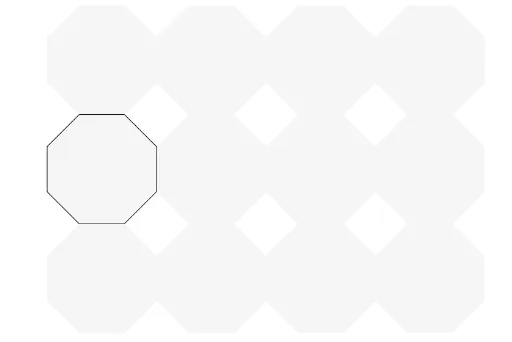
This example demonstrates the construction of regular octagons in Islamic geometric patterns. Key mathematical concepts include angles, vectors, and geometric construction. Using GeoGebra commands such as Intersect, ConstructionStep, and Point, regular octagons can be constructed. Suitable for middle school and above students to learn geometric construction and symmetry.
GeoGebra Commands & Parameters
Intersect(xAxis, yAxis) → AConstructionStep() → stapPoint(xAxis) → BPolygon(A, B, 8) → veelhoek1, f, D, E, F, G, H, g, h, i, j, k, l, m, CPolygon(D, C, 8) → veelhoek2, n, J, K, L, M, N, p, q, r, s, t, a, b, IPolygon(L, K, 8) → veelhoek3, c, P, Q, R, S, T, d, e, f_1, g_1, h_1, i_1, j_1, OPolygon(R, Q, 8) → veelhoek4, k_1, V, W, Z, A_1, B_1, l_1, m_1, n_1, p_1, q_1, r_1, s_1, UPolygon(B, A, 8) → veelhoek5, t_1, D_1, E_1, F_1, G_1, H_1, a_1, b_1, c_1, d_1, e_1, f_2, g_2, C_1Polygon(J, I, 8) → veelhoek6, h_2, J_1, K_1, L_1, M_1, N_1, i_2, j_2, k_2, l_2, m_2, n_2, p_2, I_1Polygon(P, O, 8) → veelhoek7, q_2, P_1, Q_1, R_1, S_1, T_1, r_2, s_2, t_2, a_2, b_2, c_2, d_2, O_1Polygon(V, U, 8) → veelhoek8, e_2, V_1, W_1, Z_1, A_2, B_2, f_3, g_3, h_3, i_3, j_3, k_3, l_3, U_1Polygon(F, E, 8) → veelhoek9, m_3, D_2, E_2, F_2, G_2, H_2, n_3, p_3, q_3, r_3, s_3, t_3, a_3, C_2Polygon(N, M, 8) → veelhoek10, b_3, J_2, K_2, L_2, M_2, N_2, c_3, d_3, e_3, f_4, g_4, h_4, i_4, I_2Polygon(T, S, 8) → veelhoek11, j_4, P_2, Q_2, R_2, S_2, T_2, k_4, l_4, m_4, n_4, p_4, q_4, r_4, O_2Polygon(B_1, A_1, 8) → veelhoek12, s_4, V_2, W_2, Z_2, A_3, B_3, t_4, a_4, b_4, c_4, d_4, e_4, f_5, U_2Midpoint(j) → C_3Midpoint(k) → D_3Midpoint(l) → E_3Midpoint(m) → F_3Midpoint(f) → G_3Midpoint(g) → H_3Midpoint(h) → I_3Midpoint(i) → J_3Segment(C_3, F_3) → g_5Segment(D_3, G_3) → h_5Segment(E_3, H_3) → i_5Segment(F_3, I_3) → j_5Segment(G_3, J_3) → k_5Segment(H_3, C_3) → l_5Segment(I_3, D_3) → m_5Segment(J_3, E_3) → n_5Segment(C_3, F_3) → p_5Midpoint(s) → K_3Midpoint(p) → L_3Midpoint(a) → M_3Midpoint(b) → N_3Midpoint(q) → O_3Midpoint(r) → P_3Midpoint(t) → Q_3Midpoint(i_2) → R_3Midpoint(f_2) → S_3Midpoint(k_2) → T_3Midpoint(l_2) → U_3Midpoint(m_2) → V_3Midpoint(n_2) → W_3Midpoint(p_2) → Z_3Midpoint(g_2) → A_4Midpoint(a_1) → B_4Midpoint(b_1) → C_4Midpoint(c_1) → D_4Midpoint(d_1) → E_4Midpoint(e_1) → F_4Segment(M_3, L_3) → q_5Segment(N_3, O_3) → r_5Segment(I_3, P_3) → s_5Segment(L_3, K_3) → t_5Segment(O_3, Q_3) → a_5Segment(P_3, M_3) → b_5Segment(K_3, N_3) → c_5Segment(Q_3, I_3) → d_5Segment(G_3, D_4) → e_5Segment(B_4, E_4) → f_6Segment(C_4, F_4) → g_6Segment(D_4, S_3) → h_6Segment(E_4, A_4) → i_6Segment(F_4, G_3) → j_6Segment(S_3, B_4) → k_6Segment(A_4, C_4) → l_6Segment(O_3, T_3) → m_6Segment(R_3, U_3) → n_6Segment(S_3, V_3) → p_6Segment(T_3, W_3) → q_6Segment(U_3, Z_3) → r_6Segment(V_3, O_3) → s_6Segment(W_3, R_3) → t_6Segment(Z_3, S_3) → a_6Line(E_3, H_3) → b_6Line(K_3, L_3) → c_6Intersect(b_6, c_6) → G_4Segment(H_3, G_4) → d_6Segment(L_3, G_4) → e_6Line(C_3, H_3) → f_7Line(M_3, L_3) → g_7Line(C_4, A_4) → h_7Line(W_3, R_3) → i_7Line(E_4, A_4) → j_7Line(U_3, R_3) → k_7Intersect(i_7, h_7) → H_4Intersect(g_7, k_7) → I_4Intersect(f_7, j_7) → J_4Segment(H_3, J_4) → l_7Segment(A_4, J_4) → m_7Segment(A_4, H_4) → n_7Segment(L_3, I_4) → p_7Segment(H_4, R_3) → q_7Segment(R_3, I_4) → r_7Intersect(m_5, n_5) → K_4Intersect(m_5, p_5) → L_4Intersect(n_5, p_5) → M_4Intersect(h_5, n_5) → N_4Intersect(h_5, p_5) → O_4Intersect(i_5, p_5) → P_4Intersect(h_5, i_5) → Q_4Intersect(h_5, j_5) → R_4Intersect(i_5, j_5) → S_4Intersect(i_5, k_5) → T_4Intersect(j_5, k_5) → U_4Intersect(j_5, l_5) → V_4Intersect(k_5, l_5) → W_4Intersect(k_5, m_5) → Z_4Intersect(l_5, m_5) → A_5Intersect(l_5, n_5) → B_5PolyLine(K_4, L_4, U_4, V_4, W_4, Z_4, A_5, B_5, K_4, M_4, N_4, O_4, P_4, Q_4, R_4, S_4, T_4) → s_7PolyLine(C_3, L_4, H_3, V_4, I_3, Z_4, J_3, B_5, C_3, D_3, N_4, E_3, P_4, F_3, R_4, G_3, T_4) → t_7Midpoint(C_3, G_3) → D_5Polygon(C_3, L_4, K_4, B_5) → vierhoek1, a_7, b_7, c_7, d_7Sequence(Polygon[Rotate[C_3, (nn * 45°), D_5], Rotate[L_4, (nn * 45°), D_5], Rotate[K_4, (nn * 45°), D_5], Rotate[B_5, (nn * 45°), D_5]], nn, 0, 7) → l1Polygon(L_3, G_4, H_3, J_4, A_4, H_4, R_3, I_4) → veelhoek13, e_7, f_8, g_8, h_8, i_8, j_8, k_8, l_8Vector(A, I) → hotVector(A, F) → vertSequence(Translate[Sequence[Translate[l1, Vector[(nn * hot)]], nn, 0, 3], Vector[(mm * vert)]], mm, -1, 1) → l2Sequence(Translate[Sequence[Polygon[Translate[L_3, Vector[(nn * hot)]], Translate[G_4, Vector[(nn * hot)]], Translate[H_3, Vector[(nn * hot)]], Translate[J_4, Vector[(nn * hot)]], Translate[A_4, Vector[(nn * hot)]], Translate[H_4, Vector[(nn * hot)]], Translate[R_3, Vector[(nn * hot)]], Translate[I_4, Vector[(nn * hot)]]], nn, 0, 2], Vector[(mm * vert)]], mm, 0, 1) → l3Polygon(B, H_1, I, C) → vierhoek2, b_8, m_8, i_9, c_8Sequence(Translate[Sequence[Polygon[Translate[B, Vector[(nn * hot)]], Translate[H_1, Vector[(nn * hot)]], Translate[I, Vector[(nn * hot)]], Translate[C, Vector[(nn * hot)]]], nn, 0, 2], Vector[(mm * vert)]], mm, 0, 1) → l4
AI Drawing Prompt Reference
Draw an Islamic geometric pattern composed of multiple regular octagons that connect around a central point to form a symmetrical star shape. The pattern centers on the intersection of two perpendicular axes, with multiple octagons extending outward, each side of which intersects the sides of adjacent octagons, creating a complex geometric design. Maintain symmetry and geometric precision in the pattern.
The prompt above was compiled from the original drawing commands and is for reference only.