
Constructing Rectangles: Open Middle Problem
Loading the math board and drawing, please wait…
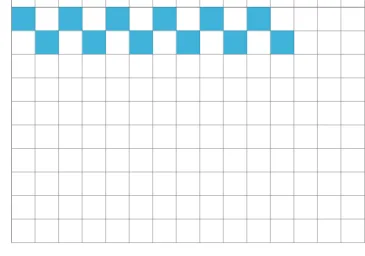
This example demonstrates how to construct rectangles (and related squares) by using geometric constraints, focusing on an “open middle” problem where an intermediate condition is not fully closed. It centers on rectangle/square properties, and uses related ideas such as area–perimeter relationships, similar triangles to justify parallel/perpendicular relationships, and 2D vector/coordinate reasoning to locate vertices. Pythagoras’ theorem is also conceptually used to verify side lengths and diagonal consistency. From the GeoGebra construction summary, the build is carried out mainly with the Polygon and Textfield commands: Polygon generates a sequence of polygon objects poly1, poly1_1, poly1_2, …, poly1_39, while Textfield provides labels for key intermediate results, enabling students to compare construction variants and observe how the open middle affects possible configurations. Suitable for middle and early college levels as an exploration activity for geometry construction and modeling.
GeoGebra Commands & Parameters
Polygon((0, 7), (1, 7), 4) → poly1Polygon((9, 8), (10, 8), 4) → poly1_{1}Polygon((4, 9), (5, 9), 4) → poly1_{2}Polygon((8, 9), (9, 9), 4) → poly1_{3}Polygon((10, 9), (11, 9), 4) → poly1_{4}Polygon((3, 8), (4, 8), 4) → poly1_{5}Polygon((6, 9), (7, 9), 4) → poly1_{6}Polygon((5, 8), (6, 8), 4) → poly1_{7}Polygon((1, 8), (2, 8), 4) → poly1_{8}Polygon((1, 6), (2, 6), 4) → poly1_{9}Polygon((7, 8), (8, 8), 4) → poly1_{10}Polygon((11, 8), (12, 8), 4) → poly1_{11}Polygon((0, 9), (1, 9), 4) → poly1_{12}Polygon((2, 7), (3, 7), 4) → poly1_{13}Polygon((2, 9), (3, 9), 4) → poly1_{14}Polygon((4, 7), (5, 7), 4) → poly1_{15}Polygon((3, 6), (4, 6), 4) → poly1_{16}Polygon((6, 7), (7, 7), 4) → poly1_{17}Polygon((5, 6), (6, 6), 4) → poly1_{18}Polygon((8, 7), (9, 7), 4) → poly1_{19}Polygon((7, 6), (8, 6), 4) → poly1_{20}Polygon((10, 7), (11, 7), 4) → poly1_{21}Polygon((9, 6), (10, 6), 4) → poly1_{22}Polygon((0, 5), (1, 5), 4) → poly1_{23}Polygon((11, 6), (12, 6), 4) → poly1_{24}Polygon((2, 5), (3, 5), 4) → poly1_{25}Polygon((1, 4), (2, 4), 4) → poly1_{26}Polygon((4, 5), (5, 5), 4) → poly1_{27}Polygon((3, 4), (4, 4), 4) → poly1_{28}Polygon((6, 5), (7, 5), 4) → poly1_{29}Polygon((5, 4), (6, 4), 4) → poly1_{30}Polygon((8, 5), (9, 5), 4) → poly1_{31}Polygon((7, 4), (8, 4), 4) → poly1_{32}Polygon((10, 5), (11, 5), 4) → poly1_{33}Polygon((9, 4), (10, 4), 4) → poly1_{34}Polygon((0, 3), (1, 3), 4) → poly1_{35}Polygon((11, 4), (12, 4), 4) → poly1_{36}Polygon((2, 3), (3, 3), 4) → poly1_{37}Polygon((1, 2), (2, 2), 4) → poly1_{38}Polygon((4, 3), (5, 3), 4) → poly1_{39}Polygon((3, 2), (4, 2), 4) → poly1_{40}Polygon((6, 3), (7, 3), 4) → poly1_{41}Polygon((5, 2), (6, 2), 4) → poly1_{42}Polygon((8, 3), (9, 3), 4) → poly1_{43}Polygon((7, 2), (8, 2), 4) → poly1_{44}Polygon((10, 3), (11, 3), 4) → poly1_{45}Polygon((9, 2), (10, 2), 4) → poly1_{46}Polygon((0, 1), (1, 1), 4) → poly1_{47}Polygon((11, 2), (12, 2), 4) → poly1_{48}Polygon((2, 1), (3, 1), 4) → poly1_{49}Polygon((1, 0), (2, 0), 4) → poly1_{50}Polygon((4, 1), (5, 1), 4) → poly1_{51}Polygon((3, 0), (4, 0), 4) → poly1_{52}Polygon((6, 1), (7, 1), 4) → poly1_{53}Polygon((5, 0), (6, 0), 4) → poly1_{54}Polygon((8, 1), (9, 1), 4) → poly1_{55}Polygon((7, 0), (8, 0), 4) → poly1_{56}Polygon((10, 1), (11, 1), 4) → poly1_{57}Polygon((9, 0), (10, 0), 4) → poly1_{58}Polygon((11, 0), (12, 0), 4) → poly1_{60}Textfield(a) → InputBox1
AI Drawing Prompt Reference
Draw a series of rectangles, each with two vertices, arranged from left to right and top to bottom. Start by drawing the bottom row of rectangles from (0,7) to (1,7), (2,7) to (3,7), and so on, until (12,7). Then draw the second row from (0,6) to (1,6), (2,6) to (3,6), and so on, until (12,6). Continue drawing the remaining rows until (12,1).
The prompt above was compiled from the original drawing commands and is for reference only.