
Area of a Kite (Deltoid) on a Grid - Level 1
Loading the math board and drawing, please wait…
In collections
Deltoid - Flächeninhalt
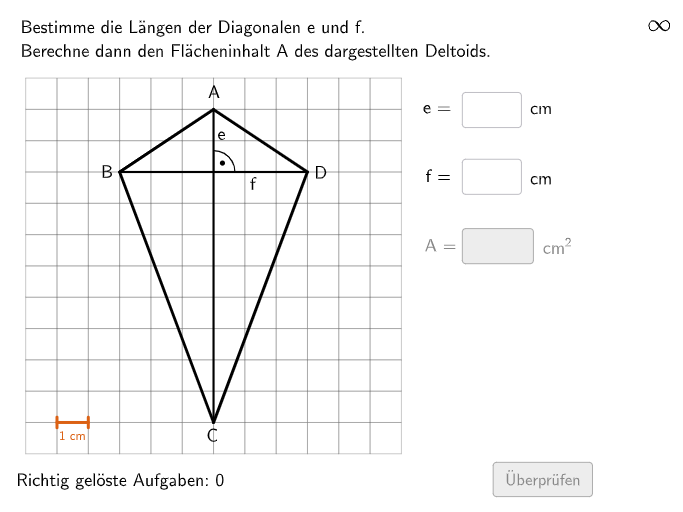
This GeoGebra example demonstrates how to calculate the area of a kite (deltoid) placed on a grid, at a basic practice level. The core mathematical concept involves applying and justifying area formulas for special quadrilaterals such as parallelograms, trapezoids, kites, and rhombi, with emphasis on decomposing the kite into triangles or using the diagonal product formula. The construction uses commands like Polygon to create the kite vertices, Segment for edges and diagonals, Random and Shuffle to generate random grid positions, and interactive elements such as Textfield, Button, and validation objects (validate, showanswer) to provide immediate feedback. It is designed for students in grades 5-6, suitable for classroom exercises or self-study, reinforcing geometric reasoning and arithmetic skills.
GeoGebra Commands & Parameters
Join(Sequence[Shuffle[{2, 3, 4, 5}], m, 1, 30]) → listEHShuffle(Sequence[Random[7, coordheight - 2], m, 1, 100]) → randomNosForX, {10, 7, 9, 8, 8, 9, 8, 7, 9, 9, 7, 7, 9, 7, 9, 7, 9, 9, 8, 8, 10, 10, 8, 10, 10, 9, 8, 10, 7, 10, 7, 9, 8, 8, 7, 7, 7, 7, 9, 10, 7, 7, 8, 9, 8, 7, 10, 8, 7, 10, 10, 7, 10, 10, 9, 8, 9, 9, 10, 9, 9, 10, 10, 8, 7, 7, 9, 7, 7, 9, 10, 10, 9, 10, 7, 8, 10, 9, 10, 9, 9, 7, 10, 9, 7, 7, 9, 9, 9, 10, 8, 9, 10, 9, 9, 9, 9, 7, 8, 8}Element(randomNosForX, Mod[questionCount, 100] + 1) → numXShuffle(Sequence[Random[4, coordwidth - 2], m, 1, 100]) → randomNosForY, {6, 9, 5, 8, 8, 7, 7, 6, 8, 6, 8, 7, 4, 8, 7, 5, 7, 4, 9, 10, 4, 9, 6, 6, 9, 10, 6, 9, 10, 9, 8, 7, 9, 9, 4, 5, 4, 9, 8, 6, 10, 8, 6, 6, 6, 4, 8, 5, 5, 4, 9, 10, 7, 5, 5, 10, 7, 6, 6, 9, 8, 7, 5, 8, 10, 9, 7, 7, 6, 7, 7, 6, 9, 6, 5, 9, 10, 8, 9, 6, 8, 9, 9, 8, 4, 9, 10, 5, 7, 8, 5, 4, 7, 7, 8, 8, 5, 5, 9, 4}Element(randomNosForY, Mod[questionCount, 100] + 1) → numYSegment(P1, P3) → esTextfield(input1) → InputBox1Textfield(input2) → InputBox2Polygon(PtopLeftCornerFeedback, PtopRightCornerFeedback, PbottomRightCornerFeedback, PbottomLeftCornerFeedback) → rectangleCorrect, rectangleCorrectS3, rectangleCorrectS4, rectangleCorrectS2, rectangleCorrectS1Append(true, Sequence[If[randomNosForX(i) ≟ randomNosForX(i - 1), false, true], i, 2, 100]) → stayXAppend(true, Sequence[If[randomNosForY(i) ≟ randomNosForY(i - 1), false, true], i, 2, 100]) → stayYRemove(Sequence[If[stayX(i), randomNosForX(i), 0], i, 1, 100], Sequence[0, i, 1, 100]) → randomNosForXwithoutRepeatRemove(Sequence[If[stayY(i), randomNosForY(i), 0], i, 1, 100], Sequence[0, i, 1, 100]) → randomNosForYwithoutRepeatElement(randomNosForXwithoutRepeat, Mod[questionCount, Length[randomNosForXwithoutRepeat]] + 1) → numXwithoutRepeatElement(randomNosForYwithoutRepeat, Mod[questionCount, Length[randomNosForYwithoutRepeat]] + 1) → numYwithoutRepeatFlatten(Sequence[Sequence[O + (m * (size, 0)) + (j * (0, size)), m, 0, coordwidth - 1], j, 0, coordheight - 1]) → listPointsRandom(2, numX - 2) → propSegment(P4, P2) → fsSegment(G1, G2) → gTranslate(Segment[(0, -0.1), (0, 0.1)], G1) → hTranslate(Segment[(0, -0.1), (0, 0.1)], G2) → iIntersect(es, fs) → STextfield(input3) → InputBox3Zip(Polygon[P, P + (0, size), P + (0, size) + (size, 0), P + (size, 0)], P, listPoints) → listCoordsAngle(P2, Midpoint[P2, P4], P1) → α
AI Drawing Prompt Reference
Draw a kite (deltoid) on a coordinate grid by placing four vertices and connecting them in order to form a closed quadrilateral. Construct two diagonals: one joining the pair of top vertices and the pair of bottom vertices to form the main diagonal, and another joining the remaining opposite vertices so that the diagonals intersect at a point. Draw the diagonal segments and the kite edges. Add an angle mark at an appropriate vertex position, using the diagonal and an adjacent side/ray so the angle is visibly defined near the intersection. Optionally leave space on the canvas for an input area related to the kite’s area.
The prompt above was compiled from the original drawing commands and is for reference only.