
Constructing and Verifying the Triangle Angle Sum
Loading the math board and drawing, please wait…
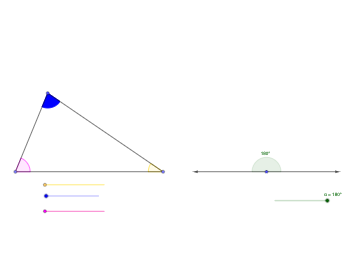
This example demonstrates the geometric phenomenon that the interior angles of a triangle add up to 180°, using interactive constructions and angle measurements. Key concepts include triangle interior angles, angle construction/measurement, and using vector-based rotation to align directions so the angle relationships become visually testable. Construction highlights: Vector and Rotate are used to rotate side directions around a vertex; Angle is used to build and label the interior angles; Segment and Point define triangle vertices and angle endpoints; Circle, Intersect, and CircleSector help locate relevant points/arc regions for angle positioning, while Distance and Midpoint support consistency checks of constructed elements. Suitable for middle/high school geometry learning, classroom demonstrations, and student-driven construction tasks.
GeoGebra Commands & Parameters
Vector(A, B) → uRotate(B, α, A) → B'Vector(A, B') → vAngle(B, A, B') → βSegment(C, E) → fPoint(f) → FPoint(f) → GSegment(H, F) → gSegment(F, G) → hSegment(G, H) → iCircle(F, 1) → cCircle(H, 1) → dCircle(G, 1) → eIntersect(c, g, 1) → LIntersect(c, h, 1) → MIntersect(d, g, 1) → NIntersect(d, i, 1) → OIntersect(e, i, 1) → PIntersect(e, h, 1) → QCircleSector(F, M, L) → kCircleSector(G, P, Q) → pCircleSector(H, N, O) → qDistance(A, F) → s1Distance(A, G) → s2Vector(I, J) → wSegment(I, J) → jSegment(K, R) → lPoint(j) → SPoint(l) → TVector(I, S) → aVector(K, T) → bSegment(I, J) → mMidpoint(H, A) → URotate(q, (-γ), U) → q'
AI Drawing Prompt Reference
Draw a triangle ABC and construct its three interior angles using vectors and rotation tools, then measure the angles. Start by creating vector u from point A to B, then rotate point B around A to form vector v, and measure the angle β between u and v. Next, define the other two vertices of the triangle, C, D, and E, and use circles and intersection tools to locate the positions of the angles, constructing three arcs k, p, and q. Finally, measure the angles to verify that the sum of the interior angles of the triangle is 180 degrees.
The prompt above was compiled from the original drawing commands and is for reference only.