
Congruent Angles: Definition Demo
Loading the math board and drawing, please wait…
In collections
Geometry: Introductory Definitions, Postulates, Theorems
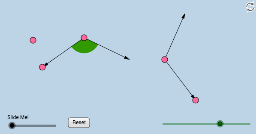
This example dynamically illustrates to students what it means for two angles to be congruent under geometric transformations, covering core concepts like congruence, rotation, translation, and geometric transformations. It is constructed using GeoGebra commands such as Circle, Point, Rotate, Angle, Vector, Segment, Intersect, CircleSector, Line, Dilate, and Translate, making it suitable for middle school and above learning geometric transformations and congruent angles.
GeoGebra Commands & Parameters
Circle(A, B) → cPoint(c) → CRotate(C, α, A) → C'Angle(C, A, C') → βVector(A, C) → uVector(A, C') → vSegment(A, B) → bCircle(D, b) → dPoint(d) → ERotate(E, α, D) → E'Angle(E, D, E') → γVector(D, E) → wVector(D, E') → eCircle(A, (0.3 * b)) → fCircle(D, (0.3 * b)) → gSegment(A, C) → hSegment(A, C') → iSegment(D, E) → jSegment(D, E') → kIntersect(f, h, 1) → FIntersect(f, i, 1) → GIntersect(g, j, 1) → HIntersect(g, k, 1) → ICircleSector(A, F, G) → pLine(A, j) → lIntersect(f, l, 2) → JAngle(J, A, F) → δDilate(A, If[0 < m ≤ 1, 1 - m, 0], D) → A'Vector(A, A') → nTranslate(p, n) → p'Rotate(p', If[1 < m ≤ 2, ((-(m - 1)) * δ), (-δ)], D) → p''
AI Drawing Prompt Reference
Draw a dynamic illustration of congruent angles showing how rotation and translation preserve angle size. Start by drawing a circle and a point on it, then rotate the point to get another, marking the angle sides. Next, draw circles centered at these points, find their intersections, and rotate or translate arcs. Finally, connect key points to visualize the dynamic transformation of congruent angles.
The prompt above was compiled from the original drawing commands and is for reference only.