
Congruence of Triangles by Rigid Motions
Loading the math board and drawing, please wait…
In collections
Transformations Stations
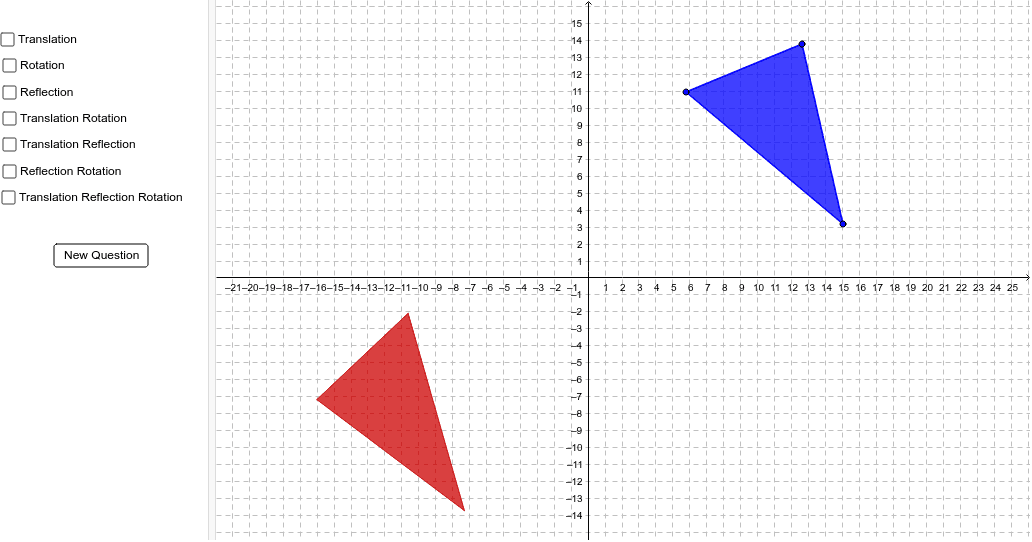
This example demonstrates the congruence of triangles by applying a series of transformations to move one triangle onto another. Key mathematical concepts include the conditions for triangle congruence and rigid motions. It utilizes commands such as Polygon, Line, Vector, Translate, Circle, Point, Angle, Mirror, Rotate, and Segment in GeoGebra. Suitable for middle school and above students to learn about geometric transformations and triangle congruence.
GeoGebra Commands & Parameters
Polygon(A, B, C) → poly1, c, a, bLine(E, D) → dVector(F, G) → vTranslate(A, v) → A'_1Translate(B, v) → B'_1Translate(C, v) → C'_1Polygon(A'_1, B'_1, C'_1) → Translation, c'_1, a'_1, b'_1Circle(H, I) → ePoint(e) → JAngle(I, H, J) → αMirror(A'_1, d) → LMirror(B'_1, d) → MMirror(C'_1, d) → NPolygon(L, M, N) → TransRef, n, l, mRotate(L, α, K) → L'Rotate(M, α, K) → M'Rotate(N, α, K) → N'Polygon(L', M', N') → TransRefRot, n', l', m'Segment(J, H) → fSegment(I, H) → gMirror(A, d) → A'Mirror(B, d) → B'Mirror(C, d) → C'Polygon(A', B', C') → Reflection, c', a', b'Rotate(A, α, K) → A'_2Rotate(B, α, K) → B'_2Rotate(C, α, K) → C'_2Polygon(A'_2, B'_2, C'_2) → Rotation, c'_2, a'_2, b'_2Rotate(A'_1, α, K) → ORotate(B'_1, α, K) → PRotate(C'_1, α, K) → QPolygon(O, P, Q) → TransRot, q, o_1, pMirror(A'_2, d) → RMirror(B'_2, d) → SMirror(C'_2, d) → TPolygon(R, S, T) → RefRot, t, r_1, sLine(V, W) → f_1Vector((0, 0), (g_1, h_1)) → u_1Translate(A, u_1) → A'_3Translate(B, u_1) → B'_3Translate(C, u_1) → C'_3Polygon(A'_3, B'_3, C'_3) → poly1', c'_3, a'_3, b'_3Rotate(A, β, U) → A'_4Rotate(B, β, U) → B'_4Rotate(C, β, U) → C'_4Polygon(A'_4, B'_4, C'_4) → poly1'_1, c'_4, a'_4, b'_4Mirror(A, f_1) → A'_5Mirror(B, f_1) → B'_5Mirror(C, f_1) → C'_5Polygon(A'_5, B'_5, C'_5) → poly1'_2, c'_5, a'_5, b'_5Rotate(A'_3, β, U) → ZRotate(B'_3, β, U) → A_1Rotate(C'_3, β, U) → B_1Polygon(Z, A_1, B_1) → poly1'', b_2, z_1, a_2Mirror(A'_3, f_1) → C_1Mirror(B'_3, f_1) → D_1Mirror(C'_3, f_1) → E_1Polygon(C_1, D_1, E_1) → poly1''_1, e_2, c_2, d_2Mirror(A'_4, f_1) → F_1Mirror(B'_4, f_1) → G_1Mirror(C'_4, f_1) → H_1Polygon(F_1, G_1, H_1) → poly2, h_2, f_2, g_2Mirror(Z, f_1) → Z'Mirror(A_1, f_1) → I_1Mirror(B_1, f_1) → J_1Polygon(Z', I_1, J_1) → poly1''', j_1, z', i_1
AI Drawing Prompt Reference
Draw two congruent triangles to demonstrate their relationship through translation, rotation, and reflection. Start by drawing a triangle, then translate it to a new position. Show how to obtain another congruent triangle by rotating and reflecting the first one. Finally, combine these transformations to verify the congruence of the triangles.
The prompt above was compiled from the original drawing commands and is for reference only.