
Prism Construction and Demonstration
Loading the math board and drawing, please wait…
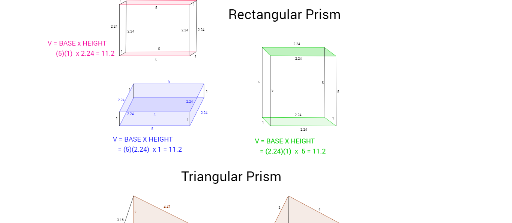
This example dynamically demonstrates the geometric construction and properties of prisms using GeoGebra. It involves core mathematical concepts such as polygons, solid geometry, and coordinate geometry. The construction utilizes commands like Polygon, Segment, Intersect, and Point, along with objects A, B, C, D, poly1, a, b, c, d, E, F, G, H, poly2, e, f, g, h, i, j, k, I, J, l, K, L, M, N, O, P, Q, R, poly3, o, p, q, r, O_1, P_1, Q_1. It is suitable for high school geometry teaching or geometric construction practice.
GeoGebra Commands & Parameters
Polygon(A, B, C, D) → poly1, a, b, c, dPolygon(E, F, G, H) → poly2, e, f, g, hSegment(F, C) → iSegment(G, B) → jSegment(H, A) → kIntersect(e, h) → IIntersect(c, d) → JSegment(I, J) → lPoint(Circle[K, 2.24]) → LPoint(Circle[L, 1]) → MPoint(Circle[M, 2.24]) → NPolygon(O, P, Q, R) → poly3, o, p, q, rPolygon(O_1, P_1, Q_1, R_1) → poly3_1, o_1, p_1, q_1, r_1Segment(P_1, P) → mSegment(Q_1, Q) → nSegment(O_1, O) → sSegment(R_1, R) → tSegment(T, U) → a_1Segment(T_1, U_1) → a_2Polygon(S, T, U, U_1) → poly4, s_1, t_1, u, u_1Segment(T_2, U_2) → a_3Polygon(S_1, T_2, U_2, U_3) → poly4_1, s_2, t_2, u_2, u_3Segment(U_2, T_2) → b_1Segment(U_3, S_1) → c_1Segment(S_1, S) → d_1Segment(U_3, U_1) → e_1Segment(U_2, U) → f_1Segment(T_2, T) → g_1Polygon(V, W, Z) → poly5, z_1, v, wPolygon(V_1, W_1, Z_1) → poly5_1, z_2, v_1, w_1Segment(W_1, W) → h_1Segment(Z_1, Z) → i_1Segment(V_1, V) → j_1Polygon(A_1, B_1, C_1) → poly6, c_2, a_4, b_2Polygon(A_2, B_2, C_2) → poly6_1, c_3, a_5, b_3Segment(C_1, C_2) → k_1Segment(B_1, B_2) → l_1Segment(A_1, A_2) → m_1