
Composite Hemisphere & Cone Mensuration Review
Loading the math board and drawing, please wait…
In collections
Mensuration
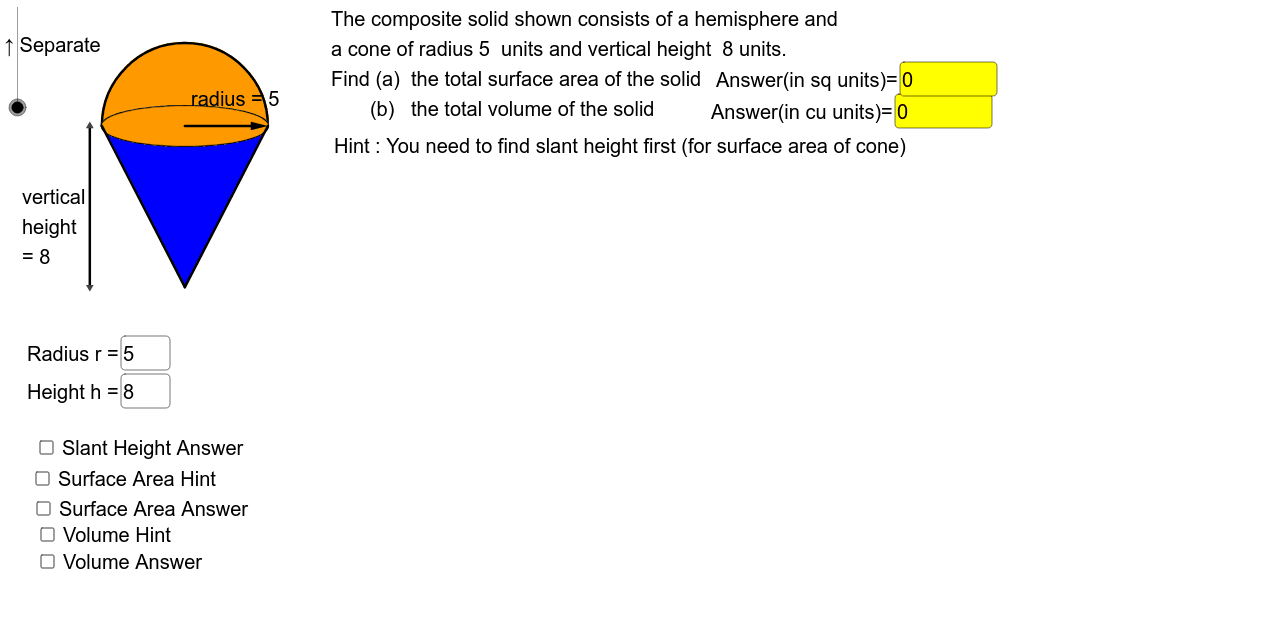
This example demonstrates the geometric mensuration and calculation process of a composite hemisphere and cone. It involves core math concepts like surface area, volume, and properties of cones and hemispheres. GeoGebra commands and objects used include Point, Ellipse, Intersect, Vector, Translate, Line, Semicircle, Textfield, If, Segment, Polygon, Midpoint. Suitable for high school students for classroom learning or self-practice to enhance understanding of solid geometry calculations.
GeoGebra Commands & Parameters
Point(xAxis) → APoint(xAxis) → BEllipse(A, B, C) → cIntersect(xAxis, yAxis) → DPoint(yAxis) → EVector(D, E) → uTranslate(c, u) → c'Intersect(c, xAxis) → F, GLine(E, xAxis) → aIntersect(c', a) → H, IVector(E, E') → vTranslate(c', v) → c''Line(E', xAxis) → eIntersect(c'', e) → J, KSemicircle(J, K) → fSemicircle(J, K) → gTranslate(c, u) → c'_1Intersect(c'', yAxis) → L, MTranslate(c', v) → c''_1Translate(c', v) → c''_2Vector(E, I) → wTextfield(r) → inputBox1Textfield(h) → inputBox2Textfield(answerTV) → inputBox4Textfield(answerTSA) → inputBox3If(abs(answerTSA - (1 / 2 * 4 * π * r^(2) + π * r * l_s)) / (1 / 2 * 4 * π * r^(2) + π * r * l_s) < 0.0050, true, false) → answerTSAcorrectIf(abs(answerTV - 3.14 * r^(2) * (2 / 3 * r + 1 / 3 * h)) / (3.14 * r^(2) * (2 / 3 * r + 1 / 3 * h)) < 0.0050, true, false) → answerTVcorrectSegment(D, H) → bSegment(D, I) → dPolygon(D, I, H) → poly1, h_1, d_1, iSegment(P_{htxtlow}, P_{htxtup}) → kMidpoint(F, H) → OVector(P_{stxtlow}, P_{stxtup}) → zVector(P_{stxtup}, P_{stxtlow}) → pMidpoint(h_1) → PMidpoint(I, D) → N
AI Drawing Prompt Reference
Draw a composite shape consisting of a hemisphere and a cone. Start by creating points A and B on the x-axis, then draw an ellipse c with A, B, and C as parameters. Find the intersection D of the x-axis and y-axis, and create point E on the y-axis. Generate vector u from DE and translate ellipse c along u to get c'. Find the intersection points F and G of c' with the x-axis, and the intersection points H and I of c' with the line through E and the x-axis. Generate vector v from EI and translate c' along v to get c''. Find the intersection points J and K of c'' with the x-axis, and the intersection points L and M of c'' with the line through E' and the x-axis. Draw semicircles f and g with J and K as diameters, and translate c' along u to get c'_1. Find the intersection points N and O of c'' with the y-axis, and translate c'' along v to get c''_1 and c''_2. Finally, draw line segments b and d from D to H and I, and triangle poly1 with vertices D, I, and H.
The prompt above was compiled from the original drawing commands and is for reference only.