
Complex Number Multiplication: Geometric Stretching and Rotation
Loading the math board and drawing, please wait…
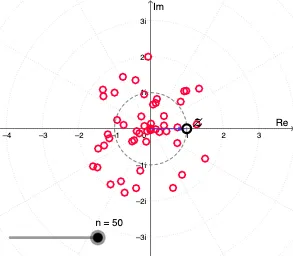
This GeoGebra example dynamically illustrates that multiplying complex numbers is geometrically equivalent to a combined stretching (or squeezing) and rotation in the complex plane. Key mathematical concepts include the correspondence between algebraic and geometric representations, multiplication of moduli, addition of arguments, and the vector interpretation of complex operations. The construction employs GeoGebra commands such as Sequence, Circle, Vector, Angle, Append, and Element to create auxiliary objects like vectors, angles, and circles, enabling learners to visualize how algebraic multiplication translates into spatial transformations. It is well-suited for high school complex number units, pre-calculus, or introductory college mathematics courses aiming to bridge algebraic computation with geometric intuition.
GeoGebra Commands & Parameters
Sequence(RandomUniform[0.01, (2 * π)], k, 1, 50) → L_2Sequence(RandomUniform[0, 2], k, 1, 50) → L_1Circle((0, 0), 1) → cVector((0, 0), Z) → uAngle((100, 0), (0, 0), Z) → αAppend(z_0, Sequence[(Element[L_1, j] * (cos(Element[L_2, j]) + (ί * sin(Element[L_2, j])))), j, 1, n - 1]) → L_3Sequence((Element[L_3, j] * Z), j, 1, Length[L_3]) → L_4Sequence(Element[L_3, j] / Z, j, 1, Length[L_3]) → L_5Element(L_4, 1) → z_1Element(L_5, 1) → z_2Vector((0, 0), z_1) → vVector((0, 0), z_2) → wVector((0, 0), z_0) → d
AI Drawing Prompt Reference
Draw the complex plane with a unit circle centered at the origin. Fix a complex number Z, shown as a vector from (0,0) to a point in the plane, and use dynamic parameters to generate multiple complex values by varying an angle in [0,2π] and a magnitude in [0,2]. Represent each generated complex number as a point and its vector from the origin. Then construct the images of these points under multiplication by Z, plotting the resulting vectors from the origin as well. Display the original vectors, the transformed (product) vectors, and the fixed vector Z together, using the unit circle and the associated angle to visualize how multiplication corresponds to combined rotation and stretching.
The prompt above was compiled from the original drawing commands and is for reference only.