
Geometric Representation of Complex Number Addition: Vector Sum and Parallelogra
Loading the math board and drawing, please wait…
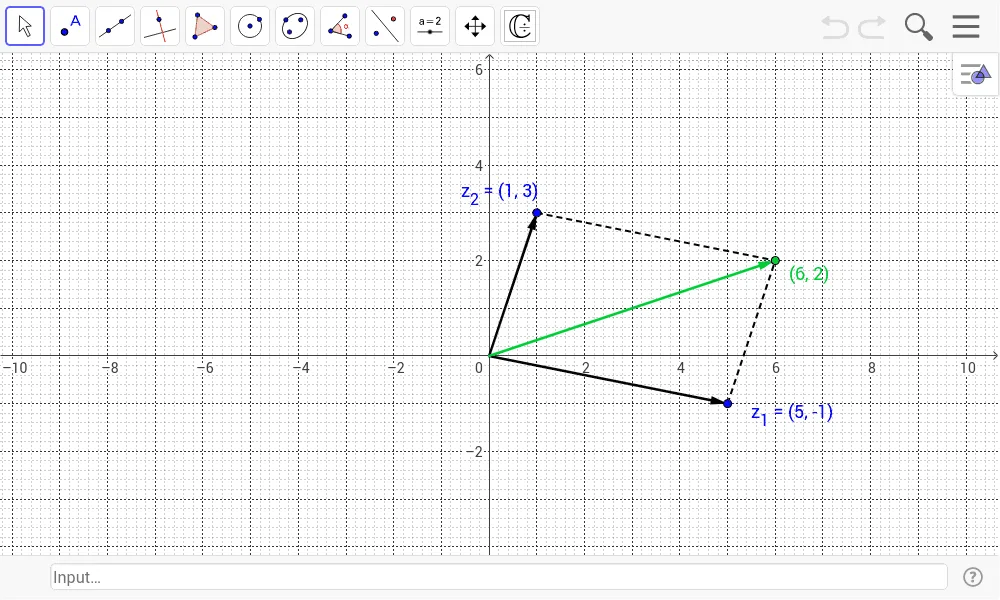
This GeoGebra example dynamically illustrates the geometric meaning of complex number addition by representing two complex numbers z₁ and z₂ as vectors in the complex planehol, and using vector addition (ComplexAddition) to construct their sum vector. The core mathematical concepts include geometric representation of complex numbers, vector addition, and the parallelogram law. Construction highlights: use the ComplexVector command to create vectors corresponding to complex numbers, the ComplexAddition command to compute the sum vector, and the Segment command to connect relevant points forming a parallelogram. Suitable for high school or early college students learning complex numbers and vector operations, providing an intuitive understanding of the equivalence between complex addition and vector composition.
GeoGebra Commands & Parameters
ComplexVector(z_2) → uComplexVector(z_1) → vComplexAddition(z_1, z_2) → CComplexVector(C) → zSegment(z_1, C) → bSegment(z_2, C) → a
AI Drawing Prompt Reference
Draw the vector representations of complex numbers z₁ and z₂ in the complex plane, and use vector addition to find their sum vector z. First, draw the vectors u and v corresponding to z₁ and z₂, then compute the sum vector z, and finally draw the line segments b connecting z₁ to z and a connecting z₂ to z, forming a parallelogram.
The prompt above was compiled from the original drawing commands and is for reference only.