
Completing the Square Demo by David T
Loading the math board and drawing, please wait…
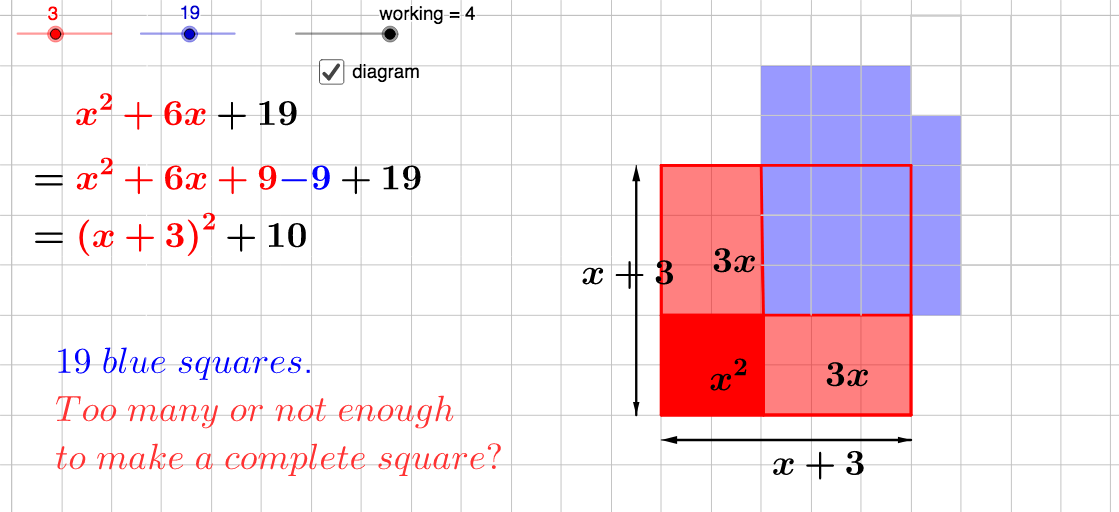
This example demonstrates the geometric process of transforming a quadratic function into vertex form through completing the square. It involves core math concepts like quadratic functions, completing the square, vertex form, and geometric transformations. The construction utilizes GeoGebra commands and objects such as Polygon, Intersect, Vector, and Midpoint. Suitable for high school mathematics teaching to help students visually understand the geometric meaning and application of completing the square.
GeoGebra Commands & Parameters
Polygon(B, D, C, A) → poly1, b_1, d, c_2, aPolygon(D, F, E, C) → poly2, d_1, f, e, c_1Polygon(G, I, D, B) → poly3, g, i, d_2, b_2Polygon(J, T, A_1, D) → poly4, j, t, a_1, d_3Polygon(B_1, Q, T, J) → poly5, b_3, q, t_1, j_1Polygon(K, P, Q, B_1) → poly6, k, p, q_1, b_4Polygon(Z_1, W_1, M, L) → poly8, z_1, w_1, m_1, l_1Polygon(A_2, B_2, W_1, Z_1) → poly9, a_2, b_5, w_2, z_2Polygon(Q, R, S, T) → poly10, q_2, r, s, t_2Polygon(T, S, J_2, A_1) → poly11, t_3, s_1, j_2, a_3Polygon(P, O, R, Q) → poly12, p_2, o, r_1, q_3Polygon(S, U, K_2, J_2) → poly13, s_2, u, k_2, j_3Polygon(R, V, U, S) → poly14, r_2, v, u_1, s_3Polygon(O, W, V, R) → poly15, o_1, w, v_1, r_3Polygon(L, M, P, K) → poly16, l_2, m_2, p_3, k_3Polygon(M, N, O, P) → poly17, m_3, n, o_2, p_4Polygon(N, Z, W, O) → poly18, n_1, z, w_3, o_3Polygon(Z, K_1, J_1, W) → poly19, z_3, k_4, j_4, w_4Polygon(W, J_1, I_1, V) → poly20, w_5, j_5, i_1, v_2Polygon(V, I_1, H_1, U) → poly21, v_3, i_2, h_1, u_2Polygon(U, H_1, C_1, K_2) → poly22, u_3, h_2, c_3, k_5Polygon(W_1, V_1, N, M) → poly7, w_6, v_4, n_2, mPolygon(V_1, U_1, Z, N) → poly23, v_5, u_4, z_4, n_3Polygon(U_1, T_1, K_1, Z) → poly24, u_5, t_4, k_1, z_5Polygon(H_1, G_1, D_1, C_1) → poly25, h_3, g_1, d_4, c_4Polygon(I_1, N_1, G_1, H_1) → poly26, i_3, n_4, g_2, h_4Polygon(J_1, M_1, N_1, I_1) → poly27, j_6, m_4, n_5, i_4Polygon(K_1, L_1, M_1, J_1) → poly28, k_6, l_3, m_5, j_7Polygon(T_1, S_1, L_1, K_1) → poly29, t_5, s_4, l_4, k_7Polygon(B_2, C_2, V_1, W_1) → poly30, b_6, c_5, v_6, w_7Polygon(C_2, D_2, U_1, V_1) → poly31, c_6, d_5, u_6, v_7Polygon(D_2, E_2, T_1, U_1) → poly32, d_6, e_2, t_6, u_7Polygon(E_2, F_2, S_1, T_1) → poly33, e_1, f_2, s_5, t_7Polygon(G_1, F_1, E_1, D_1) → poly34, g_3, f_1, e_3, d_7Polygon(N_1, O_1, F_1, G_1) → poly35, n_6, o_4, f_3, g_4Polygon(M_1, P_1, O_1, N_1) → poly36, m_6, p_1, o_5, n_7Polygon(L_1, Q_1, P_1, M_1) → poly37, l_5, q_4, p_5, m_7Polygon(S_1, R_1, Q_1, L_1) → poly38, s_6, r_4, q_5, l_6Polygon(F_2, G_2, R_1, S_1) → poly39, f_4, g_5, r_5, s_7Intersect(a, c_2) → HIntersect(b_2, g) → H_2Intersect(g_5, f_4) → L_2Intersect(e, f) → M_2Polygon(H, O_2, P_2, N_2) → poly40, h, o_6, p_6, n_8Vector(U_2, V_2) → lVector(V_2, U_2) → a_4Midpoint(U_2, V_2) → W_2Vector(A_3, Z_2) → e_4Vector(Z_2, A_3) → a_5Midpoint(A_3, Z_2) → B_3Polygon(H_3, J_3, 4) → poly41, h_5, j_8, f_5, i_5, K_3, L_3
AI Drawing Prompt Reference
Create a geometric illustration showing the transformation of a quadratic function into vertex form via completing the square. Include multiple polygons, constructed through intersections and vectors, highlighting the vertex, axis of symmetry, and the function's graph. Start with basic polygons and build up to a complex structure that visually demonstrates the geometric meaning of completing the square.
The prompt above was compiled from the original drawing commands and is for reference only.