
Complementary and Supplementary Angles: Quick Recap
Loading the math board and drawing, please wait…
In collections
Congruence (Vol 1)
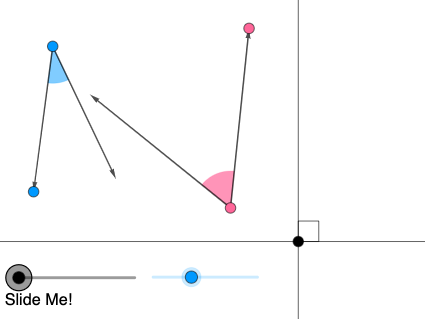
This example demonstrates the concepts of complementary and supplementary angles. Key mathematical concepts include angle measurement and classification. Using GeoGebra commands such as rotation, ray, and circle, the construction process of angles is shown. Suitable for middle and high school students to learn basic geometry.
GeoGebra Commands & Parameters
Rotate(f, pi / 2 - α, E) → f'OrthogonalLine(E, f) → iAngle(i, f) → βRay(F, G) → nCircle(F, 2) → pIntersect(p, n, 1) → HRotate(H, α, F) → H'CircleSector(F, H, H') → qRay(F, H') → rRay(I, J) → sCircle(I, 2) → tIntersect(t, s, 1) → KRotate(K, pi / 2 - α, I) → K'Ray(I, K') → bCircleSector(I, K, K') → c_1Line(E, s) → gPoint(f) → APoint(g) → BAngle(A, E, B) → γDilate(I, If[0 < a ≤ 1, 1 - a, 0], E) → I'Vector(I, I') → uTranslate(c_1, u) → cRotate(c, If[0 < a ≤ 1, (a * ((2 * pi) - γ)), (2 * pi) - γ], I') → c'Point(r) → DRotate(M, pi / 2 - α, E) → M'Ray(E, M') → kPoint(r) → CAngle(C, F, L) → δDilate(F, If[1 < a ≤ 2, 2 - a, 0], E) → F'Vector(F, F') → vTranslate(q, v) → q'Rotate(q', If[1 < a ≤ 2, ((a - 1) * δ), δ], F') → q''Circle(F, G) → dCircle(I, J) → eIntersect(e, b, 1) → NIntersect(d, r) → O,Vector(F, G) → wVector(F, O) → jVector(I, J) → lVector(I, N) → mRotateText(text1, ((-pi)) / 4) → text2
AI Drawing Prompt Reference
This graphic demonstrates the concepts of complementary and supplementary angles. It includes angles, rays, circles, and points. Angles are defined through rotation and intersection, rays connect points, and circles are used to construct angles. The construction order is to first draw rays, then circles, then rotate, and finally intersect to determine angle relationships. Suitable for learning basic geometry.
The prompt above was compiled from the original drawing commands and is for reference only.