
Comparing Areas of a Triangle and a Rectangle with Equal Perimeter (Positive Rea
Loading the math board and drawing, please wait…
In collections
RectTri Area vs. Perimeter Drafts
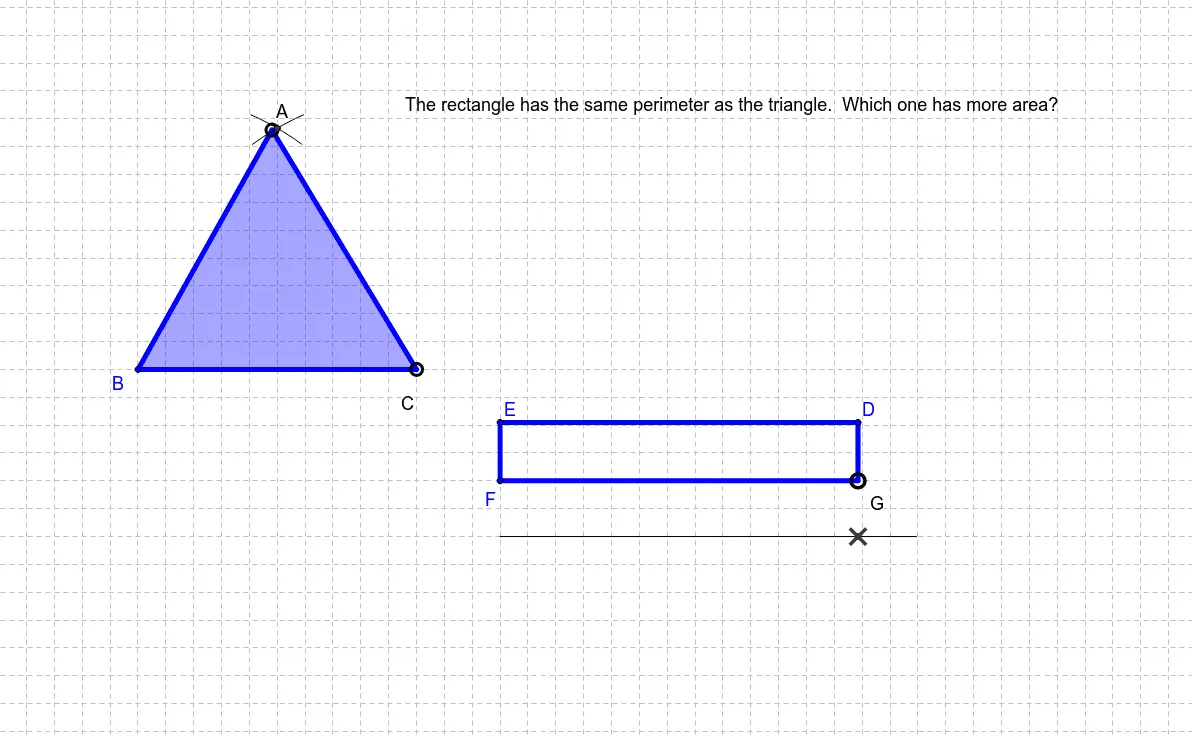
This interactive GeoGebra example demonstrates a classic geometric comparison: when a rectangle and a triangle share the same perimeter, which shape has the greater area? Users can drag vertices to reshape both figures and instantly observe how their areas change relative to each other. The core mathematical concepts involve perimeter, area, polygon properties, and reasoning about positive real numbers in an optimization context. The construction uses GeoGebra commands such as Polygon to create the triangle (poly1) and rectangle (poly2), Area and Perimeter to compute their measures, and Point, Segment, OrthogonalLine, Intersect to build auxiliary lines and intersection points. A logical variable TriGreaterArea is defined to indicate when the triangle's area exceeds the rectangle's. This resource is suitable for middle and high school geometry classes, encouraging exploration of how equal perimeters do not guarantee equal areas, and fostering dynamic visual reasoning and mathematical inquiry.
GeoGebra Commands & Parameters
Polygon(B, C, A) → poly1, a_1, b_1, c_1Area(poly1) → areaTPerimeter(poly1) → dCircle(F, d / 2) → ePoint(e) → E_1Segment(F, E_1) → fPoint(f) → GOrthogonalLine(G, f) → gOrthogonalLine(F, f) → hCircle(G, Distance[F, E_1] - Distance[F, G]) → kIntersect(k, g, 2) → DOrthogonalLine(D, g) → iIntersect(h, i) → EPolygon(F, G, D, E) → poly2, d_1, f_1, g_1, h_1Segment(B, C) → aSegment(C, A) → bSegment(A, B) → cSegment(D, E) → lSegment(E, F) → mSegment(F, G) → nSegment(G, D) → pDefined(poly2) → RectDefinedSegment(H, I) → jCircle(B, C) → qCircle(C, B) → rIntersect(q, r, 1) → K