
Circle Angle Relationships: Chord, Secant, Tangent
Loading the math board and drawing, please wait…
In collections
Circles
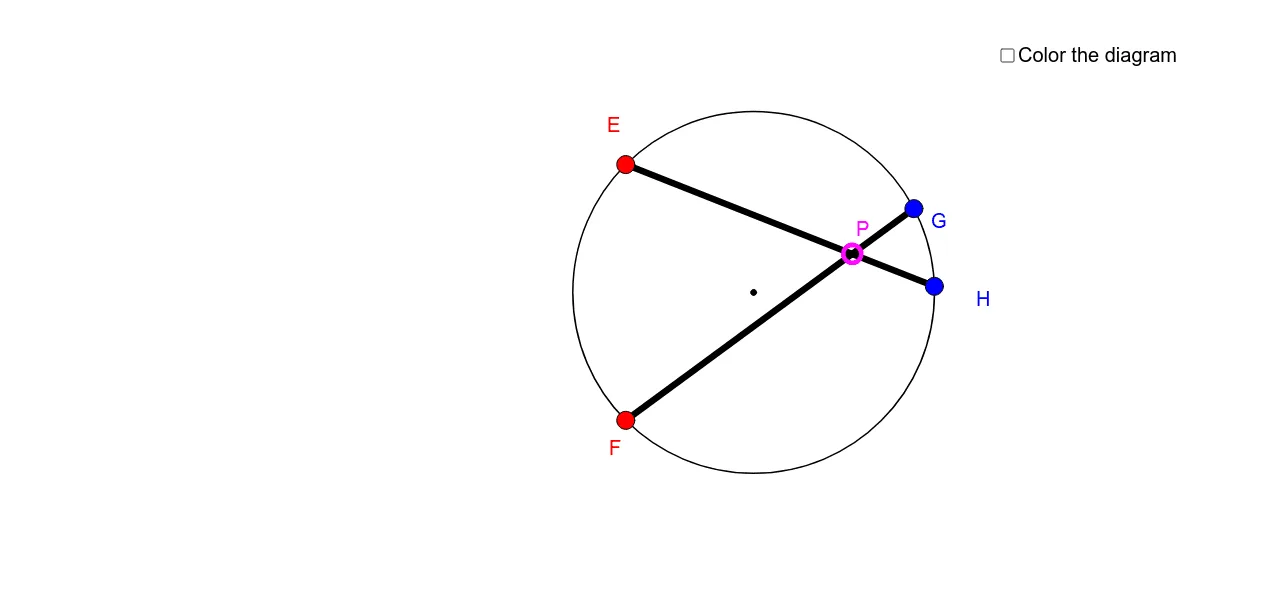
This example demonstrates the relationships between angles and arcs formed by chords, secants, and tangents in a circle. Key mathematical concepts include the Inscribed Angle Theorem, Central Angle Theorem, and Tangent-Secant Angle Theorem. The construction utilizes GeoGebra commands such as Circle, Line, OrthogonalLine, Intersect, Rotate, CircleArc, Point, Segment, Angle, CircleSector, and Dilate. It is suitable for high school mathematics education to help students visually understand the calculations and proofs of angles and arcs in circles.
GeoGebra Commands & Parameters
Circle(A, 5) → cLine(A, a) → bOrthogonalLine(A, a) → dIntersect(c, d, 2) → BRotate(B, 45*°, A) → B'Rotate(B, -45*°, A) → B'_1OrthogonalLine(B', a) → eOrthogonalLine(B'_1, a) → fIntersect(c, e, 1) → CIntersect(c, f, 1) → DCircleArc(A, B'_1, B') → gCircleArc(A, C, D) → hPoint(g) → EPoint(h) → FCircleArc(A, D, B'_1) → kPoint(k) → GPoint(k) → HLine(E, H) → iLine(G, F) → jIntersect(i, j) → PSegment(P, E) → lSegment(P, G) → mSegment(P, H) → nSegment(P, F) → pAngle(H, A, G) → Arc_2Angle(E, A, F) → Arc_1Rotate(E, (-Arc_2), A) → E'Angle(H, A, G) → γAngle(E, P, F) → AngleCircleArc(A, E, F) → qCircleArc(A, E', E) → rCircleArc(A, E, E') → sCircleSector(A, E, F) → tDilate(A, 0.05, E) → A'Rotate(A', (-Arc_2), A) → A''CircleArc(A, E, E') → c_1CircleArc(A, E, A'') → d_1CircleArc(A, A', A'') → e_1Dilate(A, 0.05, F) → A'_1Rotate(A'_1, (-Angle), A) → LRotate(L, (-Angle), A) → L'CircleArc(A, H, G) → f_1CircleArc(A, G, H) → g_1Circle(P, Segment[A, A'_1]) → h_1Intersect(h_1, p, 1) → MIntersect(h_1, l, 1) → NCircleArc(P, N, M) → k_1CircleArc(A, L, F) → p_1CircleArc(A, L', L) → q_1Segment(L, A) → a_1Segment(F, A) → b_1Segment(L', A) → i_1Segment(E, A) → j_1Angle(L', A, L) → εAngle(L, A, F) → ζSegment(A, F) → l_1Circle(A_1, 5) → c_2Line(A_1, a_2) → b_3OrthogonalLine(A_1, a_2) → d_2Intersect(c_2, d_2, 2) → B_1Rotate(B_1, 45*°, A_1) → B'_2Rotate(B_1, -45*°, A_1) → B'_3OrthogonalLine(B'_2, a_2) → e_2OrthogonalLine(B'_3, a_2) → f_2Intersect(c_2, e_2, 1) → C_1Intersect(c_2, f_2, 1) → D_1CircleArc(A_1, B'_3, B'_2) → g_2CircleArc(A_1, C_1, D_1) → h_2Point(g_2) → E_1Point(h_2) → F_1CircleArc(A_1, D_1, B'_3) → k_2Angle(E_1, A_1, F_1) → β_1CircleArc(A_1, E_1, F_1) → q_2CircleSector(A_1, E_1, F_1) → t_1Segment(F_1, A_1) → b_2Segment(E_1, A_1) → j_2Segment(A_1, F_1) → l_2