
Circle Unwrapping
Loading the math board and drawing, please wait…
In collections
Circles
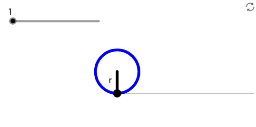
This example demonstrates how a circle unfolds into a straight line, visually illustrating geometric transformations and the relationship between 3D and 2D representations. Key math concepts include geometric transformations, polygons, circles, and inequalities. Construction highlights the use of commands like Segment, Point, Sequence, Midpoint, and Polygon in GeoGebra. Suitable for high school students and above studying spatial geometry, transformations, and net development, as well as for educational demonstrations.
GeoGebra Commands & Parameters
Segment(A, ((2 * π), 0)) → fPoint(f) → CSequence(Dilate[C, i / n, B], i, 1, n, 1) → list1Sequence(Dilate[C', i / n, B], i, 1, n, 1) → list2Sequence((x(Element[list1, i]), y(B)), i, 1, n) → list1ASequence(Rotate[Element[list1, i], (180° * (π - x(C)) / π), Element[list1A, i]], i, 1, n) → list1'Sequence(CircleArc[Element[list1A, i], Element[list1, i], Element[list1', i]], i, 1, n) → list1_{arc}Sequence((x(Element[list2, i]), y(B)), i, 1, n) → list2ASequence(Rotate[Element[list2, i], (-180° * (π - x(C)) / π), Element[list2A, i]], i, 1, n) → list2'Sequence(CircleArc[Element[list2A, i], Element[list2', i], Element[list2, i]], i, 1, n) → list2_{arc}Midpoint(C, C') → DSequence(Segment[Element[list1, i], Element[list2, i]], i, 1, n - 1) → list3Segment(D, C) → gSegment(D, C') → hSegment(C, C') → iSegment(A, B) → jPolygon(C, B, C') → poly1, c', c, bSegment((x(C'), y(C') - a), (x(C'), y(C') + a)) → kSegment((x(D), y(D) - a), (x(D), y(D) + a)) → lSegment(A, ((2 * π), 0)) → m