
Cavalieri's Principle Demonstration
Loading the math board and drawing, please wait…
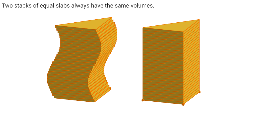
This example dynamically demonstrates Cavalieri's Principle, illustrating that two solids with equal cross-sectional areas at every height have equal volumes. Core mathematical concepts include volume, sphere, integers, parabola, rectangle, and parametric curves. Construction highlights the use of commands like Polygon, Prism, Height, If, CurveCartesian, Surface, Segment, Point, and Sequence in GeoGebra. Suitable for high school solid geometry education to visually understand the principle.
GeoGebra Commands & Parameters
Polygon(A, B, C) → poly1, c, a_1, bPrism(poly1, 3.245704115496874) → d, D, edgeCF, edgeDE, edgeEF, edgeDF, E, F, faceABED, faceBCFE, faceACFD, faceDEF, edgeAD, edgeBEHeight(d) → hIf(t < 0.5, 0, (2 * (t - 0.5))) → t2If(t < 0.5, (2 * t), 1) → t1Polygon(C', A', B') → poly2, b', c', a'CurveCartesian(f(u) + x1, y1, u, u, 0, h) → eCurveCartesian(f(u) + x2, y2, u, u, 0, h) → gCurveCartesian(f(u) + x3, y3, u, u, 0, h) → iSurface((u * (f(v) + x1)) + ((1 - u) * (f(v) + x2)), (u * y1) + ((1 - u) * y2), v, u, 0, 1, v, 0, h) → jSurface((u * (f(v) + x1)) + ((1 - u) * (f(v) + x3)), (u * y1) + ((1 - u) * y3), v, u, 0, 1, v, 0, h) → aSurface((u * (f(v) + x2)) + ((1 - u) * (f(v) + x3)), (u * y2) + ((1 - u) * y3), v, u, 0, 1, v, 0, h) → kSegment(G, G + (0, 0, h)) → lPoint(l) → HPolygon(I, J, K) → poly3, k_1, i_1, j_1Polygon(L, M, N) → poly4, n, l_1, mPolygon(O, P, Q) → poly5, q, o, pPolygon((-7, -7, h'), (7, -7, h'), (7, 7, h'), (-7, 7, h')) → poly6, r, s, b_1, c_1Segment(A, B) → d_1Segment(B, C) → e_1Segment(C, A) → f_1Sequence(Prism[Polygon[(f((i * δ)) + x1, y1, (i * δ)), (f((i * δ)) + x2, y2, (i * δ)), (f((i * δ)) + x3, y3, (i * δ))], δ], i, 0, w - 1) → list2Sequence(Prism[Polygon[(f((i * δ)) + x1, y1, (i * δ)), (f((i * δ)) + x2, y2, (i * δ)), (f((i * δ)) + x3, y3, (i * δ))], δ], i, 0, w - 1) → list2'Sequence(Prism[Polygon[A + (0, 0, (i * δ)), B + (0, 0, (i * δ)), C + (0, 0, (i * δ))], δ], i, 0, w - 1) → list1Sequence(Prism[Polygon[A + (0, 0, (i * δ)), B + (0, 0, (i * δ)), C + (0, 0, (i * δ))], δ], i, 0, w - 1) → list1'
AI Drawing Prompt Reference
Create a 3D demonstration of Cavalieri's Principle: on the left, a triangular prism with a fixed height; on the right, a curved solid with a triangular base, whose side surfaces are generated by parametric curves, and whose cross-sectional areas at each height match those of the prism. Show horizontal slices as stacks of thin prisms in both solids to illustrate equal volumes. Include a reference plane and vertical segments indicating heights. The visual should emphasize the comparison of cross-sections at corresponding heights.
The prompt above was compiled from the original drawing commands and is for reference only.