
Cavalieri's Principle by Andreas Lindner
Loading the math board and drawing, please wait…
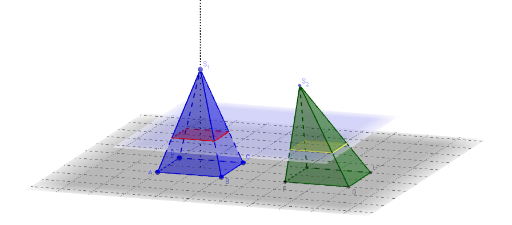
This example illustrates Cavalieri's Principle, which states that if two solid figures have equal cross-sectional areas at every level, then they have the same volume. Key mathematical concepts include solid geometry and equal areas. The construction uses GeoGebra commands such as Ray, Point, and Pyramid. Suitable for high school or university-level solid geometry.
GeoGebra Commands & Parameters
Ray((0, 0, 0), (0, 0, 1)) → strPoint(str) → S_1Pyramid(A, B, C, D, S_1) → pyr1, FlächeABCD, KanteAE, KanteBE, KanteCE, KanteDE, FlächeABE, FlächeBCE, FlächeCDE, FlächeADE, KanteAB, KanteBC, KanteCD, KanteADVector((8, 0, 0)) → uOrthogonalPlane(S_1, zAxis) → aPointIn(a) → S_2Pyramid(F, G, H, I, S_2) → pyr2, FlächeFGHI, KanteFJ, KanteGJ, KanteHJ, KanteIJ, FlächeFGJ, FlächeGHJ, FlächeHIJ, FlächeFIJ, KanteFG, KanteGH, KanteHI, KanteFIIntersectPath(ε, pyr1) → Vieleck1, E, J, K, L, c, d, e, fIntersectPath(ε, pyr2) → Vieleck2, M, N, O, P, g, i, j, k
AI Drawing Prompt Reference
Draw a geometric figure illustrating Cavalieri's Principle. The figure should include a pyramid and a prism, both having equal cross-sectional areas at different heights. The construction order starts from a point, drawing a vertical ray, then creating the first pyramid. Next, construct a vertical plane and create a second prism on it. Finally, show the cross-sections along the intersection path to demonstrate equal volumes.
The prompt above was compiled from the original drawing commands and is for reference only.