
Cardiod via Chords of a Circle
Loading the math board and drawing, please wait…
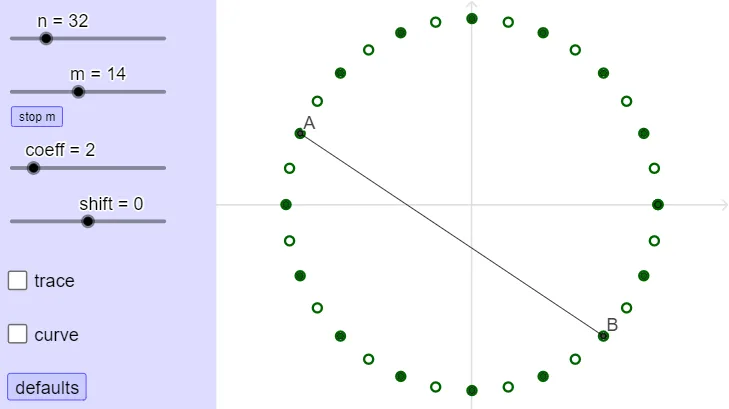
This example demonstrates how to generate a cardioid using chords of a circle. A cardioid is a special type of epicycloid that can be generated by rolling one circle around another. The example uses GeoGebra commands such as Segment, Intersect, Sequence, and CurveCartesian to illustrate the generation process. Suitable for high school mathematics education and learning coordinate geometry.
GeoGebra Commands & Parameters
Segment((R - bit, 0), (R + bit, 0)) → bIntersect(xAxis, yAxis) → CSegment(A, B) → cSequence(Rotate[D, t, C], t, 0, 6.28319, (2 * pi / n)) → list1Sequence(Rotate[D, t, C], t, 0, 6.28319, (4 * pi / n)) → list2CurveCartesian((R / (coeff + 1) * ((coeff * cos(t)) + cos((coeff * t) + ((shift * 2) * pi / n)))), (R / (coeff + 1) * ((coeff * sin(t)) + sin((coeff * t) + ((shift * 2) * pi / n)))), t, 0, (2 * pi)) → aCorner(5) → dims
AI Drawing Prompt Reference
Draw a circle and rotate points on the circle around the center to form a series of chords. The intersection points of these chords will gradually form a cardioid. Adjust the parameters to observe the generation process of the cardioid.
The prompt above was compiled from the original drawing commands and is for reference only.