
Calculus of Natural Logarithm: Integral Definition and Derivative Invariance
Loading the math board and drawing, please wait…
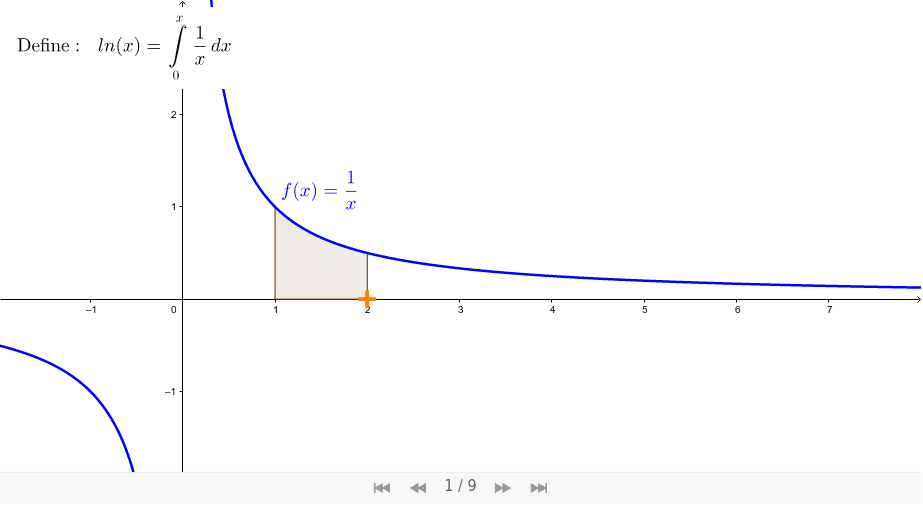
①This example dynamically illustrates the natural logarithm ln(x) defined as the integral of 1/x, and demonstrates that its derivative is independent of a constant scaling of the argument. ②Core mathematical concepts include the integral definition of the natural logarithm, the Fundamental Theorem of Calculus, the derivative of logarithmic functions, and the effect of scaling on derivatives. ③Construction highlights: using GeoGebra commands such as Point to create movable points, Integral to shade the area under the curve 1/x, Tangent and Slope to display tangent line slopes, and text objects (text1, text2, etc.) to label expressions and numerical relationships, with sliders a and b controlling integration limits and scaling factors. ④This resource is suitable for high school to undergraduate calculus courses, helping students grasp the connection between logarithms, integrals, and derivatives, and visually proving that d(ln x)/dx = d(ln(bx))/dx.
GeoGebra Commands & Parameters
Point(xAxis) → AIntegral(F, 1, xa) → aTangent(LN, fl) → fSlope(f) → m
AI Drawing Prompt Reference
Draw the graph of the natural logarithm function ln(x) defined by the integral of 1/x. Create a movable point A on the x-axis, fill the area under the curve 1/x with shading to represent the integral definition of ln(x). Use sliders to set the integration limits and display the tangent line and its slope at a point on ln(x), and show the slope of the tangent line at a point on ln(bx) to prove that the derivatives of ln(x) and ln(bx) are equal.
The prompt above was compiled from the original drawing commands and is for reference only.