
Butterfly Theorem Dynamic Illustration
Loading the math board and drawing, please wait…
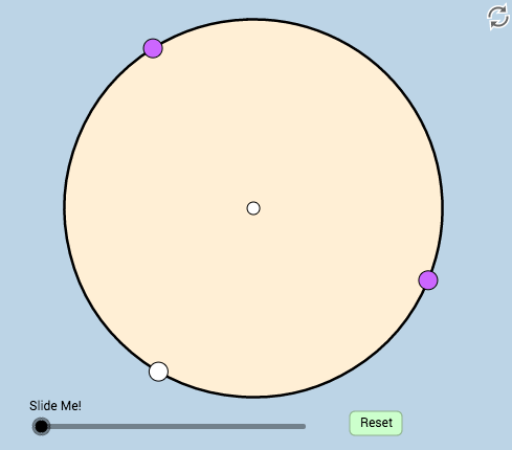
This example demonstrates the Butterfly Theorem, which states that in a circle, if two chords intersect at a point, the line segment joining the midpoints of the two chords is equal to the distance from the midpoint to the circle's center. Key mathematical concepts include circles, geometric construction, and transformations. It uses commands such as Circle, Point, CircleArc, Segment, Midpoint, Ray, Intersect, Distance, Dilate, Rotate, and Polygon in GeoGebra. Suitable for middle school and above students to learn geometric construction and theorem verification.
GeoGebra Commands & Parameters
Circle(O, R) → cPoint(c) → QPoint(c) → PCircleArc(O, Q, P) → dPoint(d) → ACircleArc(O, Q, A) → c_1Segment(P, Q) → fCircleArc(O, P, Q) → eMidpoint(f) → C_1Ray(A, C_1) → gIntersect(e, g, 1) → BPoint(c_1) → CRay(C, C_1) → hIntersect(e, h, 1) → DSegment(A, D) → iSegment(C, B) → jIntersect(f, i) → EIntersect(f, j) → FDistance(E, C_1) → distanceEC1Distance(C_1, F) → distanceC1FDilate(P, If[0 < a ≤ 1, 1 - a, 0], E) → P'Segment(P, P') → kDilate(E, If[1 < a ≤ 2, 2 - a, 0], C_1) → E'Segment(E, E') → lDilate(C_1, If[2 < a ≤ 3, 3 - a, 0], F) → GSegment(C_1, G) → mDilate(F, If[3 < a ≤ 4, 4 - a, 0], Q) → F'Segment(F, F') → nRotate(E, If[4 < a ≤ 5, ((a - 4) * π), π], C_1) → E'_1Rotate(E', If[4 < a ≤ 5, ((a - 4) * π), π], C_1) → E''Segment(E'_1, E'') → l'Rotate(P, If[4 < a ≤ 5, ((a - 4) * π), π], C_1) → P'_1Rotate(P', If[4 < a ≤ 5, ((a - 4) * π), π], C_1) → P''Segment(P'_1, P'') → k'Dilate(A, If[9.5 < a ≤ 10.5, 10.5 - a, 0], E) → A'Segment(A, A') → pDilate(E, If[10.5 < a ≤ 11.5, 11.5 - a, 0], D) → E'_2Segment(E, E'_2) → qDilate(C, If[9.5 < a ≤ 10.5, 10.5 - a, 0], F) → C'Segment(C, C') → rDilate(F, If[10.5 < a ≤ 11.5, 11.5 - a, 0], B) → F'_1Segment(F, F'_1) → sDilate(E, If[14.5 < a ≤ 15.5, 15.5 - a, 0], C_1) → E'_3Segment(E, E'_3) → tDilate(C_1, If[15.5 < a ≤ 16.5, 16.5 - a, 0], F) → HSegment(C_1, H) → bRotate(E, If[16.5 < a ≤ 17.5, ((a - 16.5) * π), π], C_1) → E'_4Rotate(E'_3, If[16.5 < a ≤ 17.5, ((a - 16.5) * π), π], C_1) → ISegment(E'_4, I) → t'CircleArc(O, A, P) → d_1Dilate(A, If[7.5 < a ≤ 8.5, 8.5 - a, 0], C_1) → A'_1Segment(A, A'_1) → f_1Dilate(C_1, If[8.5 < a ≤ 9.5, 9.5 - a, 0], B) → JSegment(C_1, J) → g_1Dilate(C, If[7.5 < a ≤ 8.5, 8.5 - a, 0], C_1) → C'_1Segment(C, C'_1) → h_1Dilate(C_1, If[8.5 < a ≤ 9.5, 9.5 - a, 0], D) → KSegment(C_1, K) → i_1Polygon(D, C_1, A) → poly1, a_1, d_2, c_2Polygon(B, C_1, C) → poly2, c_3, b_1, c_4
AI Drawing Prompt Reference
Draw a circle with two intersecting chords inside it. Find the midpoints of these chords and connect them. Demonstrate that the distance from the midpoint connection to the circle's center equals the length of the segment joining the midpoints. Use dynamic illustrations to show circles, geometric constructions, and transformations including arcs, segments, rotations, and dilations.
The prompt above was compiled from the original drawing commands and is for reference only.