
Biscribed Hexpropello Dodecahedron (Dextro) and Its Dual: Edge & Face Coloring
Loading the math board and drawing, please wait…
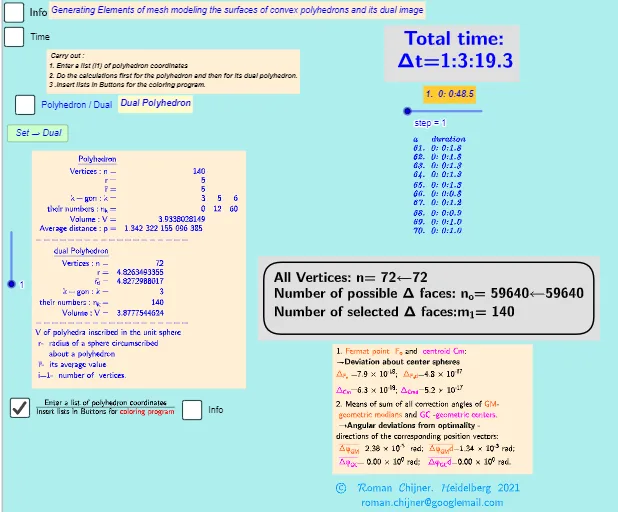
This example visualizes the structural correspondence between a biscribed Hexpropello Dodecahedron (dextro) and its dual polyhedron by coloring its edges and faces in a way that highlights the vertex–edge–face dual relationships. The key ideas are dual (paired) polyhedra, solid geometry, and geometric visualization where styling encodes adjacency/topology. Construction-wise, it uses Text and TableText to display index/parameter-based labels; Sequence to generate discrete parameter/index lists; IndexOf and First to locate starting elements; If to apply conditional rules that decide which edges/faces receive which colors or annotations; Sum to aggregate quantities computed from discrete elements; Length to measure geometric quantities such as distances/edge-related lengths; and Div together with Element to map indices (integer division and element selection) into the data driving rendering. The objects and computed variables (e.g., Volsphere, Vol, Vol_r and their dual counterparts like Volsphere_d, plus parameters such as r_d, A00d, n0, i1) support quantitative context while the coloring emphasizes the dual mapping. Suitable for advanced high-school geometry, contest preparation, and early university courses on geometry visualization and polyhedral duality.
GeoGebra Commands & Parameters
Text("" + p) → txt_pSum(Flatten[Sequence[Append[Sequence[Element[txt_p, i], i, m01(k), m02(k)], " "], k, 1, 5]]) → txtUm1If(bu0, A00, A00d) → A00_0Length(A00_0) → nLength(l2) → läl2Sequence(sgn(Determinant[{Element[A00_0, i1] - Element[A00_0, j], Element[A00_0, i2] - Element[A00_0, j], Element[A00_0, i3] - Element[A00_0, j]}]), j, 1, n) → l01Length(A00d) → zzzSum(Zip[(T * F), T, SysTimeAkt1, F, {1, 1000, 60000, 3600000, 86400000}]) → TimeAbs1Sum(Zip[(T * F), T, SysTimeAkt2, F, {1, 1000, 60000, 3600000, 86400000}]) → TimeAbs2Div(TimeRelab, 3600) → HDiv(TimeRelab - (H * 3600), 60) → MElement(ZwZeit, step) → text10TableText({Append["a duration", Last[ZwZeit, Min[10, Length[ZwZeit]]]]}, "v") → text2cLength(A00) → lm1If(Length[Unique[l01 \ {0}]] ≟ 1, 7, -7) → a7Sum(Zip[(T * F), T, SysTimeAkt0, F, {1, 1000, 60000, 3600000, 86400000}]) → TimeAbs0Div(TimeRelab0, 3600) → H0Div(TimeRelab0 - (H0 * 3600), 60) → M0Text("" + (TimeRelab0 - (H0 * 3600) - (M0 * 60))) → S0aText("" + (TimeRelab - (H * 3600) - (M * 60))) → SIndexOf(".", S) → indexIndexOf(".", S0a) → indexaFirst(S, index + 1) → txtSFirst(S0a, indexa + 1) → txtS0aIf(bu0, " ", "d") → txtbuoMax(Length[A00], Length[A00d]) → maxläElement(A00, 24) → m11TableText({{"\underline{Polyhedron}"}, Append["Vertices: n=", {Length[A00]}], Append["r=", {r}], Append["\bar{r}=", {r_m}], Append["k-gon : k=", mm5a], Append["their\; numbers: n_k=", mm7a], Append["Volume: V=", {Vol_r}], Append["Average\; distance: p=", {txtUm1}]}, "hr ") → text7TableText({{"\underline{dual\;Polyhedron}"}, Append["Vertices: n=", {Length[A00d]}], Append["r=", {r_d}], Append[" \bar{r_d}= ", {r_md}], Append["k-gon : k=", mm5ad], Append["their\; numbers: n_k=", mm7ad], Append["Volume: V=", {Vold_r}]}, "hr ") → text20
AI Drawing Prompt Reference
Draw a biscribed Hexpropello Dodecahedron (dextro) and its dual polyhedron, coloring its edges and faces to highlight the vertex-edge-face dual relationships. Include geometric parameters such as radius and vertex count, but focus on the dual structure.
The prompt above was compiled from the original drawing commands and is for reference only.