
Basic Proportionality Theorem: Proportions from Similar Triangles
Loading the math board and drawing, please wait…
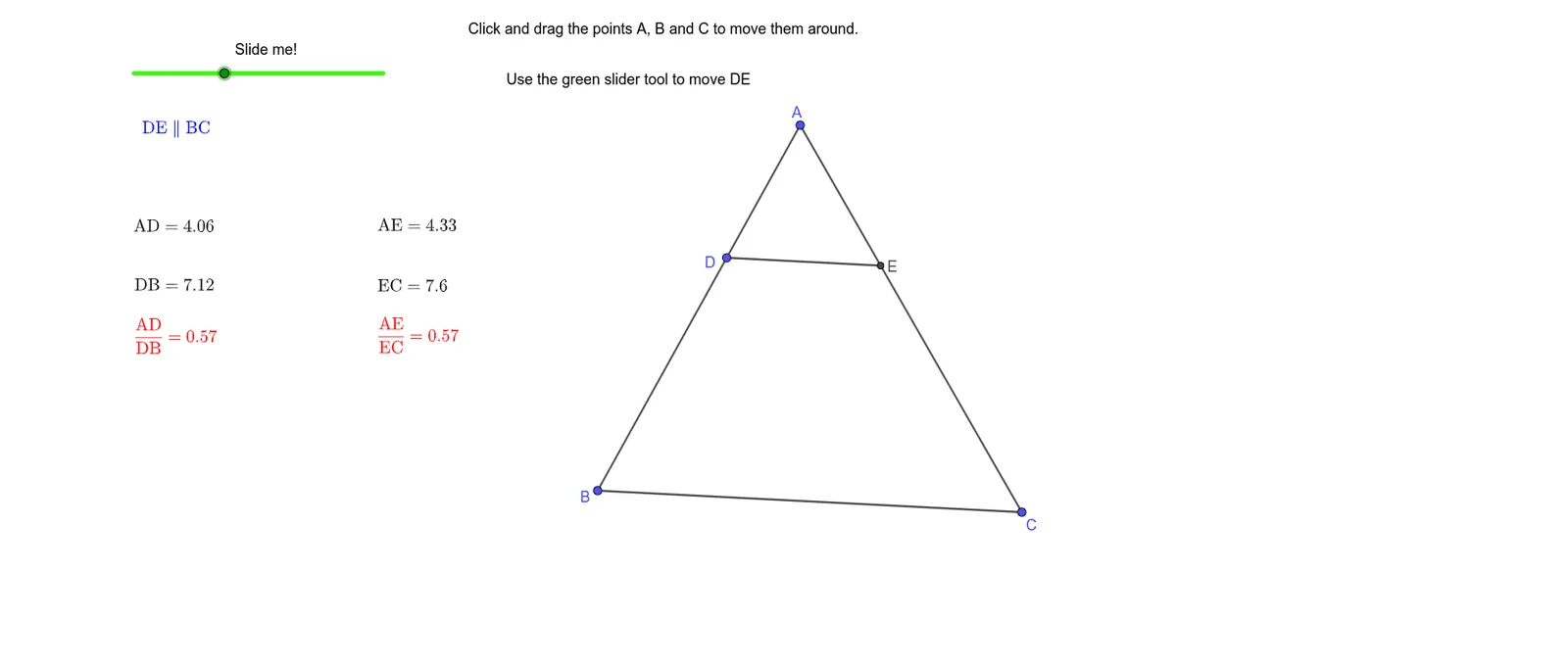
This GeoGebra example demonstrates the Basic Proportionality Theorem by constructing intersection points and segment divisions that reveal how fixed ratio relationships emerge in a triangle when lines split it in a proportion-preserving way. It centers on similar triangles and the fact that corresponding sides are proportional, turning a geometric configuration into verifiable segment ratios. The construction is built using GeoGebra commands: Segment to define the key divided edges, Line to draw the involved lines, Intersect to locate the resulting intersection (division) points, and Dilate to create a similarity/scale relationship that supports the proportionality check. The scene includes labeled points (e.g., A, B, C), drawn lines, and displayed ratio readouts (e.g., ratios with supporting text objects). Suitable for secondary-school geometry instruction, exploratory learning, and visual proof practice focused on similarity, ratios, and theorem verification.
GeoGebra Commands & Parameters
Segment(A, B) → fSegment(B, C) → gSegment(C, A) → hDilate(A, If[0 ≤ a ≤ 1, 1 - a, 0], B) → DLine(D, g) → iIntersect(i, h) → ESegment(A, D) → jSegment(D, B) → kSegment(A, E) → lSegment(E, C) → mSegment(D, E) → n
AI Drawing Prompt Reference
Draw a triangle and then draw a line on one side of the triangle that is parallel to one of its sides. Find the intersection points of this line with the other two sides of the triangle. Measure and label the lengths of these segments to demonstrate that corresponding sides of the similar triangles are proportional, verifying the Basic Proportionality Theorem.
The prompt above was compiled from the original drawing commands and is for reference only.