
Bézier Curves: Dynamic Construction and Visualization
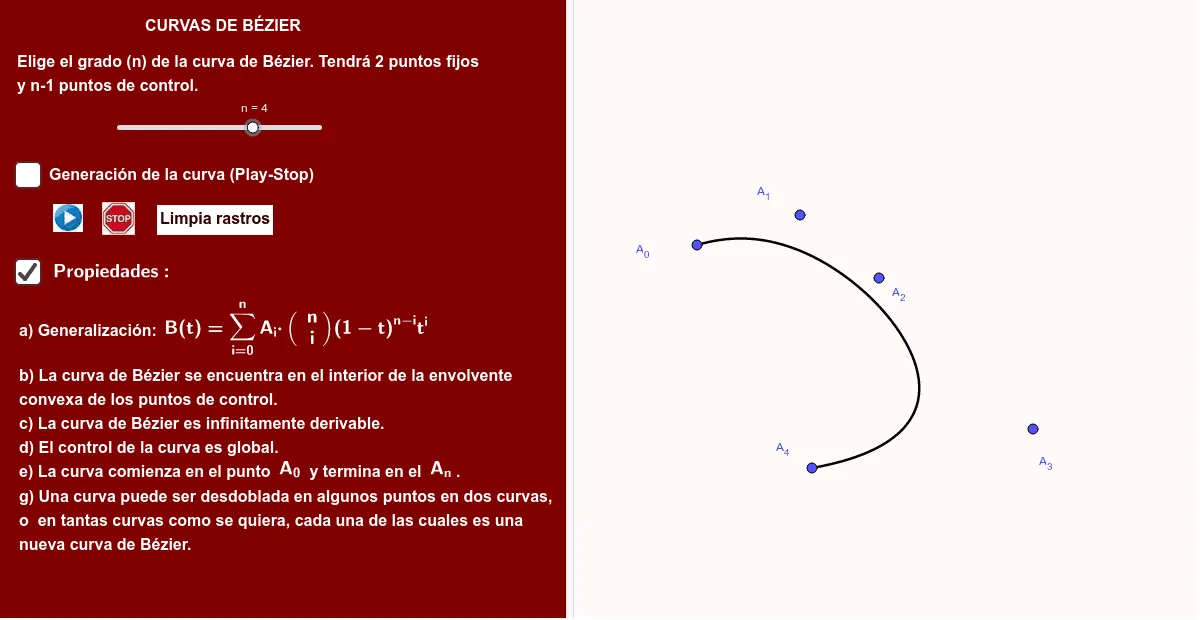
Loading the math board and drawing, please wait…
This GeoGebra example dynamically demonstrates the construction of Bézier curves, showing how a parametric curve defined by control points is generated through recursive linear interpolation to form a smooth path. Core mathematical concepts include parametric equations, control polygons, the de Casteljau algorithm, and the geometric relationship between the curve and its tangents. Construction highlights: the CurveCartesian command is used to plot the parametric curve, while Segment commands connect control points to form the control polygon; sliders and point objects (such as n, A_0 through A_5) allow real-time adjustment of control point positions, and auxiliary points (P_h, Q_h, R_h, etc.) and segments (i, j, k, l, m) illustrate the recursive interpolation steps. This example is suitable for high school to undergraduate mathematics education, helping students grasp the geometric essence of Bézier curves, parametric representation, and foundational curve design in computer graphics. It also serves as an interactive exploration activity where learners can manipulate sliders to observe how control points influence the curve's shape.
GeoGebra Commands & Parameters
CurveCartesian(((1 - t)^(2) * A_0) + (((2 * t) * (1 - t)) * A_1) + (t^(2) * A_2), t, 0, 1) → f2CurveCartesian(((1 - t)^(3) * A_0) + (((3 * t) * (1 - t)^(2)) * A_1) + (((3 * (1 - t)) * t^(2)) * A_2) + (t^(3) * A_3), t, 0, 1) → f3CurveCartesian(((1 - t)^(4) * A_0) + (((4 * t) * (1 - t)^(3)) * A_1) + (((6 * (1 - t)^(2)) * t^(2)) * A_2) + (((4 * (1 - t)) * t^(3)) * A_3) + (t^(4) * A_4), t, 0, 1) → f4CurveCartesian(((1 - t)^(5) * A_0) + (((5 * t) * (1 - t)^(4)) * A_1) + (((10 * (1 - t)^(3)) * t^(2)) * A_2) + (((10 * (1 - t)^(2)) * t^(3)) * A_3) + (((5 * (1 - t)) * t^(4)) * A_4) + (t^(5) * A_5), t, 0, 1) → f5Segment(A_0, A_1) → fSegment(A_2, A_1) → gSegment(P_h, Q_h) → iSegment(A_2, A_3) → jSegment(S_h, Q_h) → kSegment(R_h, U_h) → lSegment(A_4, A_3) → mSegment(S_h, T_h) → pSegment(U_h, V_h) → qSegment(W_h, Z_h) → rSegment(A_5, A_4) → sSegment(AA_h, T_h) → tSegment(V_h, BB_h) → aSegment(Z_h, CC_h) → bSegment(DD_h, EE_h) → c