
Tautochrone (Cycloid) Slider Animation Demo
Loading the math board and drawing, please wait…
In collections
The Domain of the Time (intuitive kinematics)
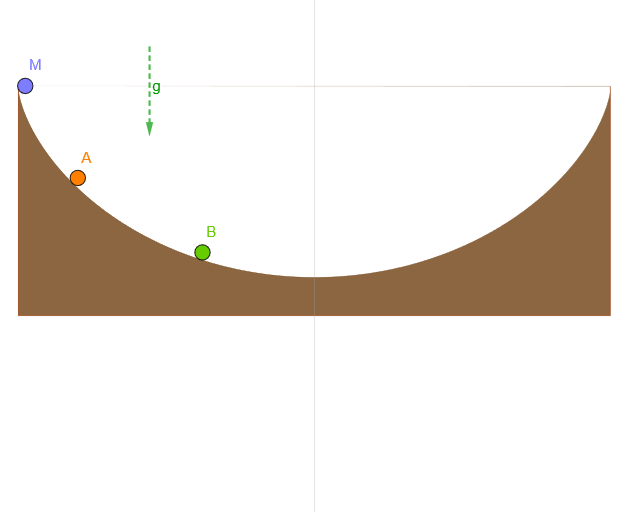
This example demonstrates the famous Tautochrone phenomenon: a point sliding along a cycloid curve reaches the lowest point in the same time regardless of its starting position. Key mathematical concepts include: parametric equations of cycloid (x=r(θ-sinθ), y=r(1-cosθ)), conservation of energy, velocity-displacement relationship, and slider animation control. GeoGebra commands used: CurveCartesian for drawing the cycloid, Point for defining start points, Tangent for finding velocity direction, UnitVector for normalizing velocity vectors, Mirror for reflecting points, and Locus for tracing trajectories. Suitable for high school parametric equation lessons, university calculus (derivatives, integrals) demonstrations, or physics mechanical energy conservation dynamic visualizations.
GeoGebra Commands & Parameters
CurveCartesian(((α * r), r) + (r; α + pi / 2), α, 0, (2 * pi)) → cPoint(c) → MIf(Length[reg] ≟ 1, {reg(1)}, Sequence[reg(k) - reg(k + 1), k, 1, Length[reg] - 1]) → regDifmean(regDif) → TTangent(M, c) → iUnitVector(i) → nPoint(c) → ATangent(A, c) → iAUnitVector(iA) → nAPoint(c) → BTangent(B, c) → iBUnitVector(iB) → nBMirror(Hnor, Line[S, S + (0, 1)]) → Hnor'Locus(P, M) → lugar1
AI Drawing Prompt Reference
Draw a cycloid where the starting point is a function of parameter α, with coordinates (α*r, r). Define a point M moving along the cycloid. Draw the tangent line i at point M and find its unit vector n. Define another point A with a tangent line iA whose unit vector nA is perpendicular to n. Define a third point B with a tangent line iB whose unit vector nB is perpendicular to n. Use the mirror operation to reflect nB in the direction of nA. Finally, trace the locus of point M to form the envelope of the cycloid.
The prompt above was compiled from the original drawing commands and is for reference only.