
Axial Reflection
Loading the math board and drawing, please wait…
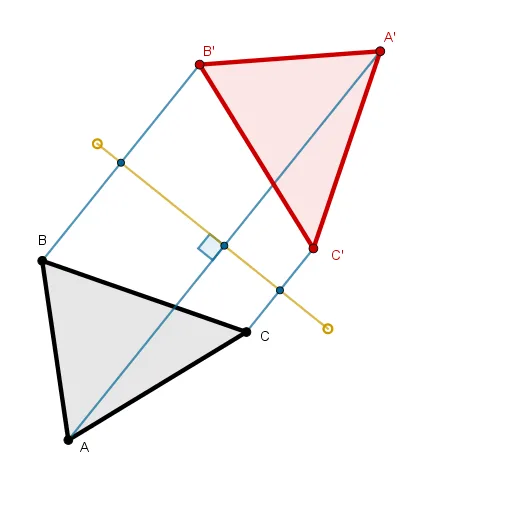
This example demonstrates axial reflection, a geometric transformation. Key mathematical concepts include reflection transformation and geometric construction. Using GeoGebra commands such as Polygon, Segment, OrthogonalLine, and Intersect, the effect of axial reflection can be constructed. Suitable for students at the junior high school level and above to learn about geometric transformations.
GeoGebra Commands & Parameters
Polygon(A, B, C) → t1, c, a, bSegment(D, E) → fOrthogonalLine(A, f) → gIntersect(g, f) → FAngle(D, F, A) → αSegment(F, A) → hMirror(A, f) → A'Segment(F, A') → iOrthogonalLine(B, f) → jIntersect(j, f) → GSegment(B, G) → kMirror(B, f) → B'Segment(G, B') → lOrthogonalLine(C, f) → mIntersect(m, f) → HSegment(H, C) → nMirror(C, f) → C'Segment(H, C') → pPolygon(A', B', C') → t1', c', a', b'
AI Drawing Prompt Reference
Draw a triangle and a straight line as the axis of symmetry. From each vertex of the triangle, draw a perpendicular line to the axis, marking the foot of the perpendicular on the axis, and connect each vertex to its foot. Then reflect each vertex across the axis to get its mirror image, and connect each foot to the corresponding reflected point. Finally, form a new triangle using the reflected points, which is the axial reflection of the original triangle.
The prompt above was compiled from the original drawing commands and is for reference only.