
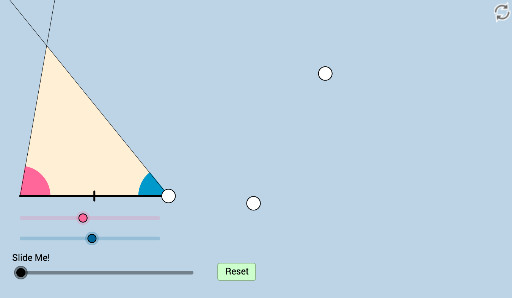
ASA Theorem Dynamic Illustration
Loading the math board and drawing, please wait…
In collections
Congruence (CO) Cluster
Congruence (Vol 1)
Congruence (Vol 1) Over 80 Resources
Geometry (Congruence) Volume 1
CCSS High School: Geometry (Congruence) Volume 1 S N ATTAR
CCSS High School: Geometry (Congruence) Volume 1
CCSS High School: Geometry (Congruence) Volume 1
CCSS High School: Geometry (Congruence) Volume 1
CCSS High School: Geometry (Congruence) Volume 1
CCSS High School: Geometry (Congruence) Volume 1
CCSS High School: Geometry (Congruence) Volume 1
CCSS High School: Geometry (Congruence) Volume 1
CCSS High School: Geometry (Congruence) Volume 1
CCSS High School: Geometry (Congruence) Volume 1
CCSS High School: Geometry (Congruence) Volume 1
CCSS High School: Geometry (Congruence) Volume 1
Triangle Theorems
CCSS High School: Geometry (Congruence) Volume 1
Unit 5: Triangle Congruence
Triangle Congruence Theorems 1
Triangle Congruence Book 1
Proving Triangles Congruent
Triangle Congruence
Triangle Congruence Demonstrations
Triangle Congruence
Unit 4 Triangle Congruence Theorems
Triangle Congruence
This example dynamically illustrates the ASA (Angle-Side-Angle) Triangle Congruence Theorem, showcasing how two triangles are congruent if two angles and the included side are equal. It involves core math concepts like triangle congruence criteria, angle measurement, and side length. The construction utilizes commands/objects such as Segment, Line, Circle, Intersect, Point, Angle, Dilate, Vector, Translate, Rotate, Ray, Polygon, Min, and CircleSector in GeoGebra. Ideal for high school mathematics education to visually aid students in understanding geometric theorems.
GeoGebra Commands & Parameters
Segment(A, B) → hLine(L, h) → i_1Circle(L, h) → rIntersect(r, i_1, 2) → ZPoint(r) → VAngle(Z, L, V) → τDilate(B, If[6 < l ≤ 7, 7 - l, 0], V) → B'_4Vector(B, B'_4) → u_1Translate(A, u_1) → A'_3Line(L, h) → tPoint(t) → PRotate(B, α, A) → B'Angle(B, A, B') → βRay(A, B') → fPoint(f) → CRotate(A, (-γ), B) → A'Angle(A', B, A) → δRay(B, A') → gIntersect(f, g) → DPolygon(A, B, D) → poly1, d, a_1, bSegment(D, B) → iSegment(D, A) → jMin({h, i, j}) → cCircle(A, (0.2 * c)) → eCircle(B, (0.2 * c)) → kIntersect(e, h) → E,Intersect(e, j) → F, IIntersect(k, h) → G,Intersect(k, i) → H, JCircleSector(A, E, F) → pCircleSector(B, H, G) → qRotate(K, β, L) → K'Angle(K, L, K') → εRay(L, K) → mIntersect(r, m, 1) → MRay(L, K') → nRotate(L, (-γ), M) → L'Angle(L', M, L) → ζRay(M, L') → sIntersect(n, s) → NDilate(A, If[0 < l ≤ 1, 1 - l, 0], L) → A'_1Vector(A, A'_1) → uTranslate(p, u) → p'Translate(F, u) → F'Point(t) → OAngle(M, L, O) → ηAngle(P, L, V) → θDilate(B, If[2 < l ≤ 3, 3 - l, 0], L) → B'_1Vector(B, B'_1) → vTranslate(A, v) → A'_2Translate(B, v) → B'_2Segment(A'_2, B'_2) → h'Rotate(A'_2, If[3 < l ≤ 4, ((l - 3) * θ), θ], L) → QRotate(B'_2, If[3 < l ≤ 4, ((l - 3) * θ), θ], L) → RSegment(Q, R) → h''Dilate(B, If[4 < l ≤ 5, 5 - l, 0], V) → B'_3Vector(B, B'_3) → wTranslate(q, w) → q'Line(M, g) → f_1Point(f_1) → SAngle(N, M, S) → τ_1Translate(B, u_1) → B'_5Translate(D, u_1) → D'Polygon(A'_3, B'_5, D') → poly1', d', a'_3, b'_5Line(V, g) → g_1Point(g_1) → WAngle(W, V, L) → σRotate(L, (-α), L) → L'_1Rotate(K', (-α), L) → K''Ray(L'_1, K'') → n'Line(B, L) → h_1Rotate(p', If[1 < l ≤ 2, ((l - 1) * τ), τ], L) → p''Rotate(q', If[5 < l ≤ 6, ((l - 5) * (σ - γ)), σ - γ], Q) → q''Translate(A, v) → A'_4Translate(B', v) → B''Rotate(A'_4, θ, L) → A_1Rotate(B'', θ, L) → B'''Rotate(V, α, L) → V'Angle(V, L, V') → ιRay(L, V') → j_1Rotate(L, (-γ), V) → L'_2Angle(L'_2, V, L) → κRay(V, L'_2) → k_1Intersect(j_1, k_1) → TAngle(T, V, W) → λRotate(A'_3, If[7 < l ≤ 8, ((-(l - 7)) * λ), (-λ)], V) → URotate(B'_5, If[7 < l ≤ 8, ((-(l - 7)) * λ), (-λ)], V) → B_1Rotate(D', If[7 < l ≤ 8, ((-(l - 7)) * λ), (-λ)], V) → D''Polygon(U, B_1, D'') → poly1'', d'', u_2, b_1
AI Drawing Prompt Reference
Draw a dynamic illustration of the ASA Triangle Congruence Theorem, showing how two triangles are congruent if two angles and the included side are equal. Include two triangles, a circle, several line segments, and rays. Start by drawing a line segment, then draw a circle with this segment as the chord. Find the intersection points of the circle with the line segment. Use rotation and dilation based on angle and side relationships to construct the second triangle. Highlight key angles with arcs or sectors, differentiate parts with colors or thickness, and use a slider to dynamically adjust angles and sides to observe congruence.
The prompt above was compiled from the original drawing commands and is for reference only.