
Aristarchus' Mistake
Loading the math board and drawing, please wait…
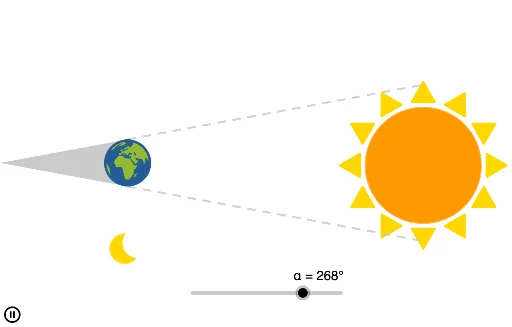
This example illustrates Aristarchus' mistake in calculating the distance between Earth and the Sun. Key mathematical concepts include trigonometry and geometric transformations. Using GeoGebra commands such as Circle, Sequence, Point, Line, Mirror, and Intersect, the relative positions of Earth and the Sun can be constructed. Suitable for high school mathematics education and learning.
GeoGebra Commands & Parameters
Circle((0, 0), r3) → kCircle(A, r) → cSequence(Rotate[Polygon[A + ((r * 1.1), (0.2 * r)), A + ((r * 1.1), (-0.2 * r)), 3], ((i * 2) * π / 12), A], i, 1, 12) → L_1Circle(B, r2) → dCircle(B + ((r2 * 0.9), (0.4 * r2)), r2) → ePoint(f) → CLine(E, F) → gMirror(F, xAxis) → F'Mirror(E, xAxis) → E'Line(E', F') → hIntersect(g, h) → GPolygon(G, F', F) → t1, f_1, g_1, f'Segment(F, E) → iSegment(F', E') → j
AI Drawing Prompt Reference
Draw a circle for the Sun and a larger circle for the Earth, showing the Earth orbiting the Sun at twelve positions. Connect a point on the Earth's orbit to the Sun. Draw a smaller circle centered on the Sun and another small circle centered on a point on the smaller circle. Mirror a line connecting the Earth's orbit point to the Sun, find the intersection of the mirrored line with the original line, and connect these points to form a quadrilateral. Finally, draw line segments connecting the intersection points.
The prompt above was compiled from the original drawing commands and is for reference only.