
Areas of Plane Figures via Geometric Transformations
Loading the math board and drawing, please wait…
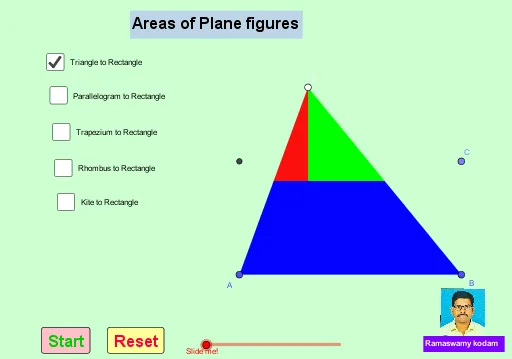
This GeoGebra example demonstrates how to compare and/or compute the areas of plane (polygonal) figures by constructing them through geometric transformations and decomposition. The key ideas are polygon area, relationships determined by lines and midpoints, and how rotations, reflections, translations, and dilations affect area (e.g., preserving area under isometries and scaling under similarity-type transforms). Construction uses GeoGebra commands to create the underlying geometry: Point, Line, Segment, Intersect (find intersections), Midpoint (compute midpoints), OrthogonalLine (draw perpendiculars), and Polygon (build regions). It then generates transformed copies using Vector (direction for translations) together with Rotate, Translate, Mirror, and Dilate to place the figures in configurations that make area correspondence and reasoning visible. The model includes many derived points/objects (such as labeled primed objects like E', I' and related construction points) to track each transformation. Suitable for secondary school through early university geometry lessons, especially for teaching area reasoning, geometric invariants, and transformation-based problem solving.
GeoGebra Commands & Parameters
Segment(A, B) → fOrthogonalLine(A, f) → gOrthogonalLine(B, f) → hPoint(h) → CLine(C, f) → iIntersect(g, i) → DMidpoint(E, A) → FMidpoint(B, E) → GOrthogonalLine(E, f) → jIntersect(f, j) → HLine(F, f) → kIntersect(j, k) → IPolygon(E, F, I) → t1, i_1, e, f_1Polygon(I, G, E) → t2, e_1, i_2, g_1Polygon(F, A, B, G) → q1, f_2, a, b, g_2Rotate(E, (π * c / 2), F) → E'Rotate(F, (π * c / 2), F) → F'Rotate(I, (π * c / 2), F) → I'Polygon(E', F', I') → t1', i', e', f'Rotate(I, ((-π) * c / 2), G) → I'_1Rotate(G, ((-π) * c / 2), G) → G'Rotate(E, ((-π) * c / 2), G) → E'_1Polygon(I'_1, G', E'_1) → t2', e'_1, i'_1, g'Segment(D, C) → lPoint(f) → JSegment(C, J) → mLine(A, m) → nIntersect(l, n) → KOrthogonalLine(K, f) → pIntersect(p, f) → LPolygon(K, A, L) → t3, l_1, k_1, a_1Polygon(L, J, C, K) → q2, l_2, j_1, c_1, k_2Vector(A, V) → uTranslate(K, u) → K'Translate(A, u) → A'Translate(L, u) → L'Polygon(K', A', L') → t3', l', k', a'Point(l) → MPoint(l) → NMidpoint(M, A) → OMidpoint(N, B) → POrthogonalLine(P, f) → qOrthogonalLine(O, f) → rIntersect(r, f) → QIntersect(q, f) → RPolygon(M, O, Q, R, P, N) → poly1, m_1, o_1, q_1, r_1, p_1, n_1Polygon(O, A, Q) → t4, q_2, o_2, a_2Polygon(R, B, P) → t5, p_2, r_2, b_1Rotate(R, (π * c / 2), P) → R'Rotate(B, (π * c / 2), P) → B'Rotate(P, (π * c / 2), P) → P'Polygon(R', B', P') → t5', p', r', b'Rotate(O, ((-π) * c / 2), O) → O'Rotate(A, ((-π) * c / 2), O) → A'_1Rotate(Q, ((-π) * c / 2), O) → Q'Polygon(O', A'_1, Q') → t4', q', o', a'_1Mirror(A, D) → A'_2Mirror(B, C) → B'_1Midpoint(A'_2, B'_1) → SMidpoint(A, B) → TMidpoint(D, C) → UPolygon(S, D, U) → t6, u_1, s_1, d_1Polygon(S, U, C) → t7, c_2, s_2, u_2Polygon(D, T, U) → t8, u_3, d_2, tPolygon(T, C, U) → t9, u_4, t_1, c_3Rotate(S, ((π * 3) * c / 4), D) → S'Rotate(D, ((π * 3) * c / 4), D) → D'Rotate(U, ((π * 3) * c / 4), D) → U'Rotate(S, (((-π) * 3) * c / 4), C) → S'_1Rotate(U, (((-π) * 3) * c / 4), C) → U'_1Rotate(C, (((-π) * 3) * c / 4), C) → C'Midpoint(A'_2, D) → WMidpoint(B'_1, C) → ZMidpoint(T, Z) → A_1Midpoint(T, W) → B_1Midpoint(S, W) → C_1Midpoint(S, Z) → D_1Segment(S, T) → h_1Segment(C_1, D_1) → h_2Segment(B_1, A_1) → j_2Intersect(j_2, h_1) → E_1Intersect(h_1, h_2) → F_1Polygon(C_1, F_1, S) → t10, s_3, m_2, n_2Polygon(F_1, D_1, S) → t11, s_4, t_2, b_2Polygon(T, A_1, E_1) → t12, e_2, t_3, f_3Polygon(E_1, B_1, T) → t13, t_4, g_3, h_3Segment(W, Z) → i_3Intersect(i_3, h_1) → G_1Polygon(F_1, G_1, Z, D_1) → q3, j_3, k_3, z_1, l_3Polygon(C_1, W, G_1, F_1) → q4, m_3, w, n_3, p_3Polygon(E_1, A_1, Z, G_1) → q5, q_3, r_3, z_2, a_3Polygon(B_1, E_1, G_1, W) → q6, b_3, d_3, e_3, w_1Rotate(C_1, (π * c / 2), C_1) → H_1Rotate(F_1, (π * c / 2), C_1) → I_1Rotate(S, (π * c / 2), C_1) → S'_2Polygon(H_1, I_1, S'_2) → t10', s'_2, f_4, g_4Rotate(F_1, ((-π) * c / 2), D_1) → J_1Rotate(D_1, ((-π) * c / 2), D_1) → K_1Rotate(S, ((-π) * c / 2), D_1) → S'_3Polygon(J_1, K_1, S'_3) → t11', s'_3, h_4, i_4Rotate(T, (π * c / 2), A_1) → T'Rotate(A_1, (π * c / 2), A_1) → L_1Rotate(E_1, (π * c / 2), A_1) → M_1Polygon(T', L_1, M_1) → t12', j_4, t', k_4Rotate(E_1, ((-π) * c / 2), B_1) → N_1Rotate(B_1, ((-π) * c / 2), B_1) → O_1Rotate(T, ((-π) * c / 2), B_1) → T'_1Polygon(N_1, O_1, T'_1) → t13', t'_1, l_4, m_4Midpoint(D, S) → R_1Midpoint(T, C) → S_1Midpoint(S, C) → T_1Midpoint(D, T) → U_1Dilate(R_1, If[0 < c ≤ 1, 1 - c, 0], S_1) → V_1Vector(R_1, V_1) → v_2Dilate(T_1, If[1 < c ≤ 2, 2 - c, 0], U_1) → W_1Vector(T_1, W_1) → w_2Translate(S, v_2) → S'_4Translate(D, v_2) → D'_1Translate(U, v_2) → U'_2Polygon(S'_4, D'_1, U'_2) → t6', u'_2, s'_4, d'_1Translate(S, w_2) → S'_5Translate(U, w_2) → U'_3Translate(C, w_2) → C'_1Polygon(S'_5, U'_3, C'_1) → t7', c'_1, s'_5, u'_3
AI Drawing Prompt Reference
Draw a graphic composed of multiple planar polygons to demonstrate how geometric transformations such as rotation, reflection, translation, and dilation affect area. The graphic should include original polygons and their transformed copies, which are placed via rotation and translation to show area correspondence. Key objects include points, line segments, and polygons, connected through intersections, perpendicular lines, and midpoints. The graphic should clearly illustrate the correspondence between transformed and original polygons, suitable for geometry teaching and area reasoning.
The prompt above was compiled from the original drawing commands and is for reference only.