
Area of Overlapped Regular Hexagons
Loading the math board and drawing, please wait…
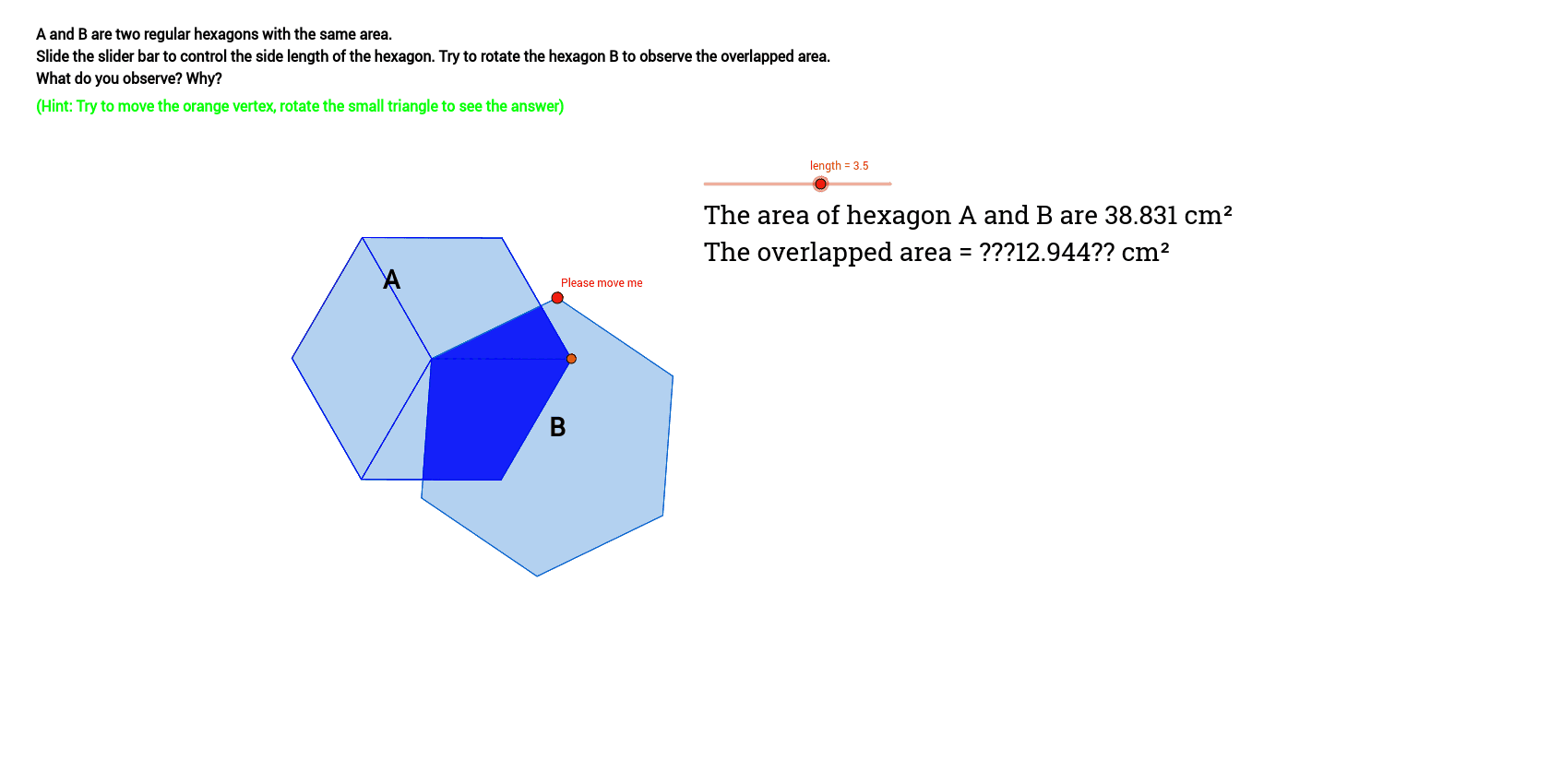
This example demonstrates how to calculate the area of the overlapped region between two regular hexagons. It involves core mathematical concepts such as polygon area calculation, geometric construction, and intersection regions. Key GeoGebra commands and objects used in the construction include Polygon, Segment, Intersect, Circle, Point, OrthogonalLine, Angle, and PointIn. Suitable for high school mathematics teaching or geometric problem exploration, helping students understand the calculation methods for overlapping polygonal areas.
GeoGebra Commands & Parameters
Polygon(B, A, 6) → poly1, b, F, a_1, c, d, e, f, C, D, ESegment(A, E) → gSegment(B, D) → hIntersect(g, h) → GCircle(G, b) → kPoint(k) → HPolygon(H, G, 6) → poly2, h_1, L, g_1, i, j, l, m, I, J, KIntersect(b, g_1) → MIntersect(c, h_1) → NPolygon(A, M, G, N, C) → poly3, n, c_1, m_1, a_2, g_2Intersect(a_1, h_1) → OIntersect(f, g_1) → PPolygon(A, B, P, G, O) → poly4, a_3, b_1, p, g_3, oIntersect(b, h_1) → QIntersect(e, g_1) → RPolygon(Q, B, F, R, G) → poly5, q, b_2, f_1, r, g_4Intersect(f, h_1) → SIntersect(d, g_1) → TPolygon(G, T, E, F, S) → poly6, g_5, t, e_1, f_2, sIntersect(c, g_1) → UIntersect(e, h_1) → VPolygon(U, D, E, V, G) → poly7, u, d_1, e_2, v, g_6Intersect(a_1, g_1) → WIntersect(h_1, d) → ZPolygon(W, C, D, Z, G) → poly8, w, c_2, d_2, z, g_7OrthogonalLine(G, b) → i_1Point(i_1) → A_1Segment(A_1, G) → j_1Angle(H, G, A_1) → αSegment(A, G) → aSegment(G, F) → k_1Segment(G, D) → l_1Circle(G, k_1) → p_1Point(p_1) → B_1Circle(B_1, f_2) → q_1Circle(G, s) → r_1Intersect(q_1, r_1, 2) → C_1Polygon(B_1, C_1, G) → poly9, g_8, b_3, c_3Circle(G, l_1) → s_1Point(s_1) → D_1Circle(D_1, u) → t_1Circle(G, g_6) → k_2Intersect(t_1, k_2, 1) → E_1Polygon(G, E_1, D_1) → poly10, d_3, g_9, e_3Circle(G, l_1) → p_2Point(p_2) → F_1Circle(F_1, d_2) → q_2Circle(G, z) → r_2Intersect(q_2, r_2, 2) → G_1Polygon(G, F_1, G_1) → poly11, g_{10}, g_{11}, f_3Circle(G, a) → s_2Segment(A, M) → n_1Point(s_2) → H_1Circle(H_1, n_1) → t_2Segment(M, G) → i_2Circle(G, i_2) → h_3Intersect(t_2, h_3, 1) → I_1Polygon(I_1, H_1, G) → poly12, g_{12}, i_3, h_4Circle(G, a) → k_3Point(k_3) → J_1Circle(J_1, o) → p_3Circle(G, g_3) → q_3Intersect(p_3, q_3, 2) → K_1Polygon(J_1, K_1, G) → poly13, g_{13}, j_2, k_4Circle(G, k_1) → r_3Circle(G, r) → s_3Point(r_3) → L_1Circle(L_1, f_1) → t_3Intersect(s_3, t_3, 2) → M_1Polygon(L_1, M_1, G) → poly14, g_{14}, l_2, m_2Polygon(G, T, E, F) → poly15, g_{15}, t_4, e_4, f_4Polygon(G, D, E, V) → poly16, g_{16}, d_4, e_5, v_1Polygon(G, W, C, D) → poly17, g_{17}, w_1, c_4, d_5Polygon(G, N, C, A) → poly18, g_{18}, n_2, c_5, a_4Polygon(G, A, B, P) → poly19, g_{19}, a_5, b_4, p_4Polygon(G, Q, B, F) → poly20, g_{20}, q_4, b_5, f_5PointIn(poly2) → N_1
AI Drawing Prompt Reference
Draw two regular hexagons and find their overlapping area. First, draw two regular hexagons and identify their intersection points. Center a circle at one of the intersection points and find a point on the circle. Use this point and the intersection point to draw a new regular hexagon. Then, draw multiple polygons using the sides of the hexagons and intersection points to form the boundaries of the overlapping region. Finally, measure and label the area of the overlapping region.
The prompt above was compiled from the original drawing commands and is for reference only.