
Exploring Rectangle Area Formula
Loading the math board and drawing, please wait…
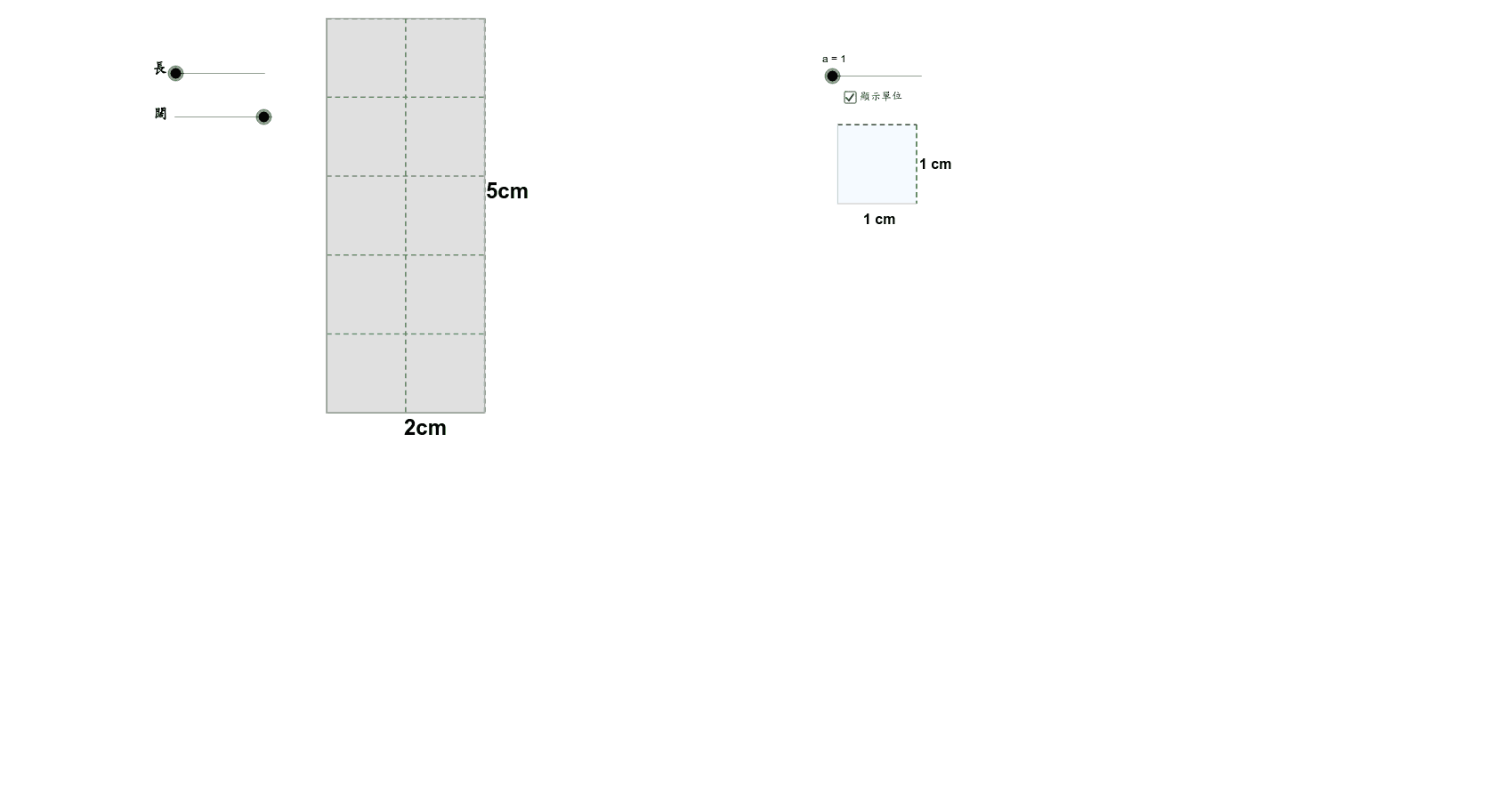
This example demonstrates how the area formula for a rectangle remains valid when the side lengths are not integers. It involves core math concepts like rectangle area formula, vectors, and coordinate geometry. Constructed using GeoGebra commands such as Point, Segment, Circle, OrthogonalLine, Intersect, Div, Sequence, and Polygon. Suitable for high school students to understand the universality of mathematical formulas.
GeoGebra Commands & Parameters
Point(Circle[A, b]) → BSegment(A, B) → cPoint(Circle[B, d]) → CSegment(B, C) → eCircle(B, C) → fOrthogonalLine(B, c) → gIntersect(f, g, 2) → DSegment(D, B) → hOrthogonalLine(D, h) → iOrthogonalLine(A, c) → jIntersect(i, j) → ESegment(E, D) → kSegment(E, A) → lDiv(4.2, 1) → mDiv(4.2, 0.5) → nSequence(E + ((D - E) / (D - E) / a * k), k, 1, Div[b, 1 / a]) → list1Sequence(A + ((B - A) / (B - A) / a * k), k, 1, Div[b, 1 / a]) → list2Sequence((x(A), y(A) + (1 / a * k)), k, 1, Div[d, 1 / a]) → list3Sequence((x(B), y(B) + (1 / a * k)), k, 1, Div[d, 1 / a]) → list4Sequence(Segment[Element[list1, k], Element[list2, k]], k, 1, Div[b, 1 / a]) → list5Sequence(Segment[Element[list3, k], Element[list4, k]], k, 1, Div[d, 1 / a]) → list6Point(h) → FPoint(c) → GPoint(Circle[H, 1]) → ISegment(H, I) → pOrthogonalLine(I, p) → qCircle(I, H) → rIntersect(r, q, 1) → JOrthogonalLine(J, q) → sOrthogonalLine(H, p) → tIntersect(s, t) → KSegment(H, K) → a_1Segment(K, J) → b_1Segment(J, I) → c_1Sequence((x(H) + (1 / a * k), y(H)), k, 1, Div[1, 1 / a]) → list7Sequence((x(K) + (1 / a * k), y(K)), k, 1, Div[1, 1 / a]) → list8Sequence((x(K), y(K) + (1 / a * k)), k, 1, Div[1, 1 / a]) → list9Sequence((x(J), y(J) + (1 / a * k)), k, 1, Div[1, 1 / a]) → list10Sequence(Segment[Element[list7, k], Element[list8, k]], k, 1, Div[1, 1 / a]) → list11Sequence(Segment[Element[list9, k], Element[list10, k]], k, 1, Div[1, 1 / a]) → list12Polygon(H, K, J, I) → poly1, h_1, k_1, j_1, i_1Polygon(A, W, M, L) → poly2, a_2, w, m_1, l_1Point(c_1) → NPoint(b_1) → O
AI Drawing Prompt Reference
Draw a rectangle to demonstrate the universality of its area formula with non-integer side lengths. Start by constructing two perpendicular sides of the rectangle. Extend lines from the vertices along these sides at proportional intervals to form a grid. Then, draw the diagonal inside the rectangle and mark equal divisions along it, connecting these points to create a grid. Finally, construct a similar shape outside the rectangle, labeling key points and segments to illustrate the applicability of the area formula.
The prompt above was compiled from the original drawing commands and is for reference only.