
Area of a Parallelogram by Ms. Muusse
Loading the math board and drawing, please wait…
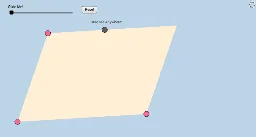
This example dynamically illustrates that the area of a parallelogram is equal to the area of a rectangle with the same base and height. Key concepts include the properties of parallelograms and area calculation methods. Using GeoGebra commands such as Line, Segment, Polygon, etc., the principle of equal area can be intuitively understood. Suitable for students at the junior high school level and above.
GeoGebra Commands & Parameters
Line(A, B) → f_1Line(A, B) → bSlope(b) → mPointIn(d) → CSegment(A, B) → aLine(C, a) → fOrthogonalLine(B, f) → nIntersect(f, n) → HSegment(C, H) → lPoint(l) → IOrthogonalLine(I, l) → qIntersect(q, a) → JCircle(B, Distance[A, J]) → g_1Intersect(g_1, f_1, 2) → MSegment(A, C) → ePoint(f) → DRay(C, D) → gLine(B, e) → hIntersect(h, g) → ESegment(C, E) → iSegment(B, E) → jPoint(i) → FOrthogonalLine(A, i) → kAngle(B, A, C) → αRay(C, E) → pIntersect(f, k) → GSegment(G, E) → rPoint(r) → KOrthogonalLine(K, r) → sIntersect(s, a) → LPolygon(A, J, I, C) → poly1, a_1, j_1, i_1, c_1Polygon(J, B, E, I) → poly2, j_2, b_1, e_1, i_2Polygon(A, L, K, C) → poly3, a_2, l_1, k_1, c_2Polygon(L, B, E, K) → poly4, l_2, b_2, e_2, k_2Dilate(I, If[0 < o ≤ 1, 1 - o, 0], J) → I'Segment(I, I') → tAngle(J, I, E) → βDilate(J, If[2 < o ≤ 3, 3 - o, 0], M) → J'Vector(J, J') → uAngle(B, J, I) → γOrthogonalLine(E, b) → d_1Translate(A, u) → A'Translate(J, u) → J'_1Translate(I, u) → I'_1Translate(C, u) → C'Polygon(A', J'_1, I'_1, C') → poly1', a', j'_1, i'_1, c'Angle(I'_1, J', J) → δPolygon(A, B, E, C) → poly5, a_3, b_3, e_3, c_3Circle(E, Distance[C, K]) → h_1Intersect(h_1, f, 2) → NPolygon(A, B, E, C) → poly6, a_4, b_4, e_4, c_4Dilate(K, If[0 < o ≤ 1, 1 - o, 0], L) → K'Segment(K, K') → m_1Angle(L, K, E) → εAngle(B, L, K) → ζDilate(K, If[2 < o ≤ 3, 3 - o, 0], N) → K'_1Vector(K, K'_1) → vTranslate(A, v) → A'_1Translate(L, v) → L'Translate(K, v) → K'_2Translate(C, v) → C'_1Polygon(A'_1, L', K'_2, C'_1) → poly3', a'_1, l', k'_2, c'_1Angle(K'_1, L', A) → η
AI Drawing Prompt Reference
Draw a parallelogram and demonstrate that its area is equal to the area of a rectangle with the same base and height. Start by drawing the base AB of the parallelogram, then draw a line f1 through points A and B. Next, take a point C on line f1 and draw a line f parallel to AB through C, intersecting at point H. Connect CH and draw a line q perpendicular to CH, intersecting AB at point I. Then, draw a circle g1 centered at B with radius BI, intersecting line f1 at point M. Connect AC and draw a line p parallel to AB through C, intersecting f at point G. Connect GE and draw a circle s centered at G with radius GE, intersecting AB at point L. Finally, draw parallelograms ACIJ, JBEI, CLIK, and LEJK, and adjust the position of point I to show equal areas.
The prompt above was compiled from the original drawing commands and is for reference only.