
Area Model vs Factored Form vs Standard Form
Loading the math board and drawing, please wait…
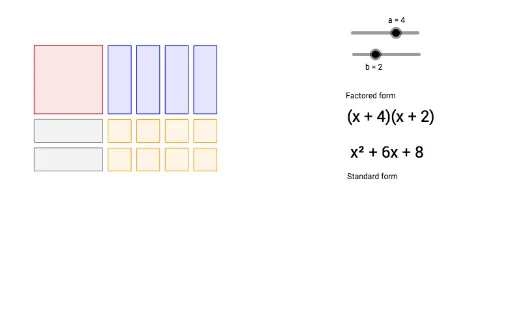
This example uses the area model to demonstrate the relationship between factored form and standard form of polynomials. Key mathematical concepts include polynomials, factoring, and standard form. It utilizes commands like Polygon and Sequence in GeoGebra. Suitable for students in middle school and above to learn different representations of polynomials.
GeoGebra Commands & Parameters
Polygon(A, B, D, C) → poly1, a_1, e, d, cSequence(Polygon[(3.25 + (1.25 * n), 3), (4.25 + (1.25 * n), 3), (4.25 + (1.25 * n), 0), (3.25 + (1.25 * n), 0)], n, 0, a - 1, 1) → list1Sequence(Polygon[(0, -0.25 - (1.25 * n)), (0, -1.25 - (1.25 * n)), (3, -1.25 - (1.25 * n)), (3, -0.25 - (1.25 * n))], n, 0, b - 1, 1) → list2Sequence(Sequence[Polygon[(3.25 + (1.25 * n), -0.25 - (1.25 * m)), (4.25 + (1.25 * n), -0.25 - (1.25 * m)), (4.25 + (1.25 * n), -1.25 - (1.25 * m)), (3.25 + (1.25 * n), -1.25 - (1.25 * m))], n, 0, a - 1, 1], m, 0, b - 1, 1) → list3
AI Drawing Prompt Reference
Draw an area model illustrating the relationship between factored form and standard form of a polynomial. Start with a large rectangle with its bottom-left corner at the origin, width 3, and height 3. To the right of this large rectangle, draw a vertical column of a smaller rectangles, each with width 1.25 and height 3, aligned along the right edge. Below the large rectangle, draw a horizontal row of b smaller rectangles, each with width 3 and height 1.25, aligned along the bottom edge. Finally, in the bottom-right corner, draw a grid of a rows and b columns of small squares, each with side length 1.25, filling the remaining area. All rectangles should have black outlines and be unfilled.
The prompt above was compiled from the original drawing commands and is for reference only.