
Archytas Curve
Loading the math board and drawing, please wait…
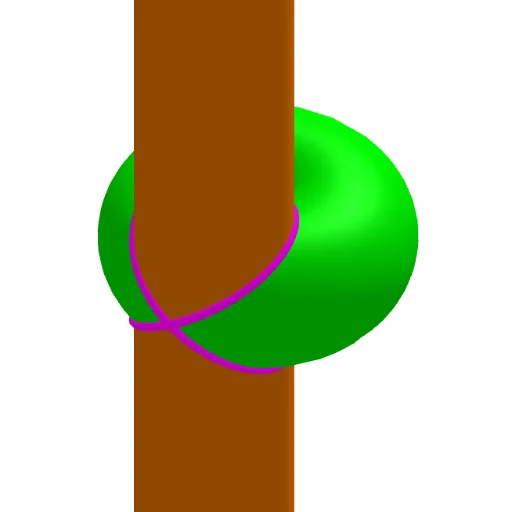
This example demonstrates the construction and visualization of the Archytas Curve, the first algebraic curve discovered by the ancient Greek mathematician Archytas. It involves core mathematical concepts such as cylinders, surfaces, Cartesian curves, and parametric equations. The construction utilizes GeoGebra commands like Cylinder, Surface, and CurveCartesian. Suitable for high school and above students to understand the relationship between spatial geometry and algebraic curves.
GeoGebra Commands & Parameters
Cylinder((0, 0, -10), (0, 0, 10), 1) → a, c, d, bSurface(((1 + cos(u)) * cos(v)) + 1, ((1 + cos(u)) * sin(v)), sin(u), v, 0, (2 * π), u, 0, (2 * π)) → eCurveCartesian(1 - (2 * cos(t)^(2)), ((2 * cos(t)) * sin(t)), (2 * sqrt(((1 - cos(t)) * cos(t)))), t, ((-π)) / 2, π / 2) → fCurveCartesian(1 - (2 * cos(t)^(2)), ((2 * cos(t)) * sin(t)), (-2 * sqrt(((1 - cos(t)) * cos(t)))), t, ((-π)) / 2, π / 2) → g
AI Drawing Prompt Reference
Draw the Archytas curve, an algebraic curve formed by a cylinder and a surface. The curve consists of two surfaces and a parametric curve, illustrating the relationship between spatial geometry and algebraic curves. The construction order is to first draw the cylinder, then create the surface, and finally draw the parametric curve.
The prompt above was compiled from the original drawing commands and is for reference only.