
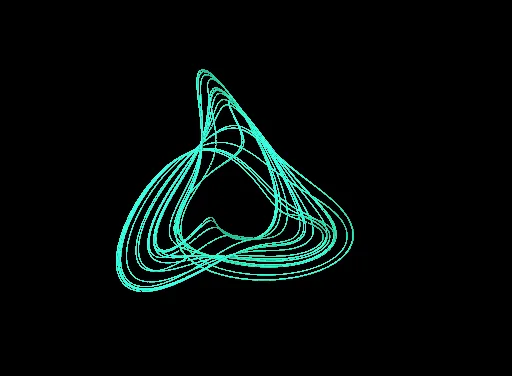
Halvorsen Attractor
Loading the math board and drawing, please wait…
This example demonstrates the fractal structure and dynamic evolution of the Halvorsen attractor. Key mathematical concepts include fractal geometry, ordinary differential equations, iterative sequences, and 3D visualization. Construction highlights involve LaTeX for mathematical formula rendering, NSolveODE for numerical solutions of differential equations, Length for length calculations, Sequence for generating sequences, PolyLine for drawing multi-segment lines, and If for conditional logic. Suitable for high school students and above, university beginners, and those learning 3D graphics and numerical simulation of differential equations.
GeoGebra Commands & Parameters
LaTeX(x', true, true) → text1LaTeX(y', true, true) → text2LaTeX(z', true, true) → text3NSolveODE({x', y', z'}, 0, {x0, y0, z0}, 30) → numericalIntegral1, numericalIntegral2, numericalIntegral3Length(numericalIntegral1) → lenSequence((y(Point[numericalIntegral1, i]), y(Point[numericalIntegral2, i]), y(Point[numericalIntegral3, i])), i, 0, 1, 1 / len) → L_1PolyLine(L_1) → fIf(len ≟ len, 0, 1) → val
AI Drawing Prompt Reference
Create the 3D structure of the Halvorsen attractor by solving differential equations with NSolveODE to get numerical integrals, then calculate the length of the integrals, generate a sequence of points, and connect them with PolyLine to show the dynamic evolution of the attractor.
The prompt above was compiled from the original drawing commands and is for reference only.