
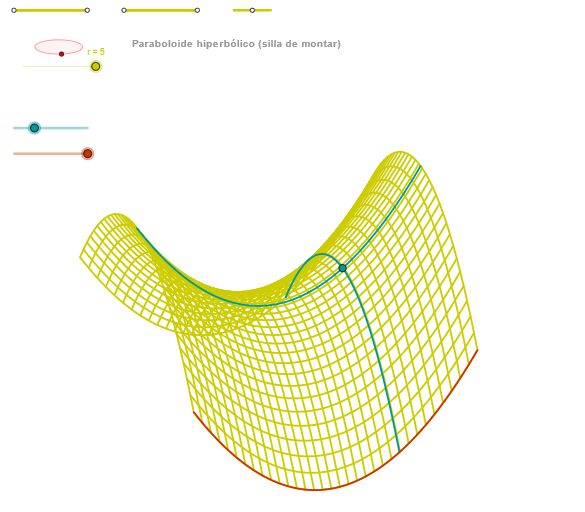
Hyperbolic Paraboloid (Saddle Surface) Construction
Loading the math board and drawing, please wait…
In collections
geometriadinamica.es
This example demonstrates the construction of a hyperbolic paraboloid, also known as a saddle surface, which is an important quadric surface in analytic geometry. The surface can be represented by the equation z=x²/a²-y²/b². Key mathematical concepts include: the geometric properties of the hyperbolic paraboloid (saddle shape, two families of parabolic curves), parametric representation, and horizontal cross-sections (ellipses and hyperbolas). Construction highlights: Using CurveCartesian command to draw parametric curves, Sequence command to generate curve families, Point and Intersect commands to locate critical points, and Ellipse command to show horizontal cross-sections at different heights. Suitable for high school to university students studying analytic geometry, solid geometry, and parametric equations.
GeoGebra Commands & Parameters
Segment(Q3, Q4) → p2Point(p2) → P3Segment(P3, Q4) → p4Point(p4) → P4Segment(Q1, Q2) → p1Point(p1) → P1Segment(P1, Q2) → p3Point(p3) → P2OrthogonalLine(C, yAxis) → zz1Circle(C, 0.62) → zz0Intersect(zz0, zz1, 1) → ZZ1Intersect(zz0, zz1, 2) → ZZ2Ellipse(ZZ1, ZZ2, 0.65) → zElipse1Intersect(zElipse1, zz1) → ZZ5, ZZ6Point(zElipse1) → XYAngle(ZZ6, C, XY) → zAngRotOrthogonalLine(C, xAxis) → zz2Intersect(zz0, zz2, 2) → ZZ3Intersect(zz0, zz2, 1) → ZZ4Ellipse(ZZ3, ZZ4, 0.65) → zElipse2Intersect(zElipse2, zz2) → ZZ7, ZZ8Point(zElipse2) → ZAngle(ZZ8, C, Z) → zAngIncSegment(Q5, Q6) → p5Point(p5) → P5CurveCartesian(((r * u) * sin(zAngRot)), (r * ((((-u) * cos(zAngRot)) * sin(zAngInc)) + (u^(2) * cos(zAngInc)))), u, u1, u2) → curva1Segment(ZZ5, ZZ6) → zz4Segment(ZZ7, ZZ8) → zz3Intersect(zElipse2, zElipse1, 1) → zPunto1Intersect(zElipse2, zElipse1, 4) → zPunto2Segment(zPunto1, zPunto2) → zSeg2CurveCartesian((r * (((α * r / 6) * sin(zAngRot)) + (v * cos(zAngRot)))), (r * (((((-α) * r / 6) * cos(zAngRot)) * sin(zAngInc)) + ((v * sin(zAngRot)) * sin(zAngInc)) + ((((α * r / 6))^(2) - v^(2)) * cos(zAngInc)))), v, v1, v2) → curva2CurveCartesian((r * ((u * sin(zAngRot)) + ((β * r / 6) * cos(zAngRot)))), (r * ((((-u) * cos(zAngRot)) * sin(zAngInc)) + (((β * r / 6) * sin(zAngRot)) * sin(zAngInc)) + ((u^(2) - ((β * r / 6))^(2)) * cos(zAngInc)))), u, u1, u2) → aSequence(CurveCartesian[(r * ((u * sin(zAngRot)) + (v * cos(zAngRot)))), (r * ((((-u) * cos(zAngRot)) * sin(zAngInc)) + ((v * sin(zAngRot)) * sin(zAngInc)) + ((u^(2) - v^(2)) * cos(zAngInc)))), v, v1, v2], u, u1, u2, paso) → list2Sequence(CurveCartesian[(r * ((u * sin(zAngRot)) + (v * cos(zAngRot)))), (r * ((((-u) * cos(zAngRot)) * sin(zAngInc)) + ((v * sin(zAngRot)) * sin(zAngInc)) + ((u^(2) - v^(2)) * cos(zAngInc)))), u, u1, u2], v, v1, v2, paso) → list1
AI Drawing Prompt Reference
Draw a hyperbolic paraboloid (saddle surface) with equation z = x²/a² - y²/b². Start with two horizontal elliptical cross-sections at different heights, intersecting each other. Mark their intersection points. From these points, generate two families of parabolic curves forming a grid on the surface: one family curves upward, the other downward, creating the saddle shape. Add several auxiliary line segments connecting corresponding points on the ellipses to show the construction. Present the surface in 3D perspective, emphasizing its symmetry and hyperbolic nature.
The prompt above was compiled from the original drawing commands and is for reference only.