
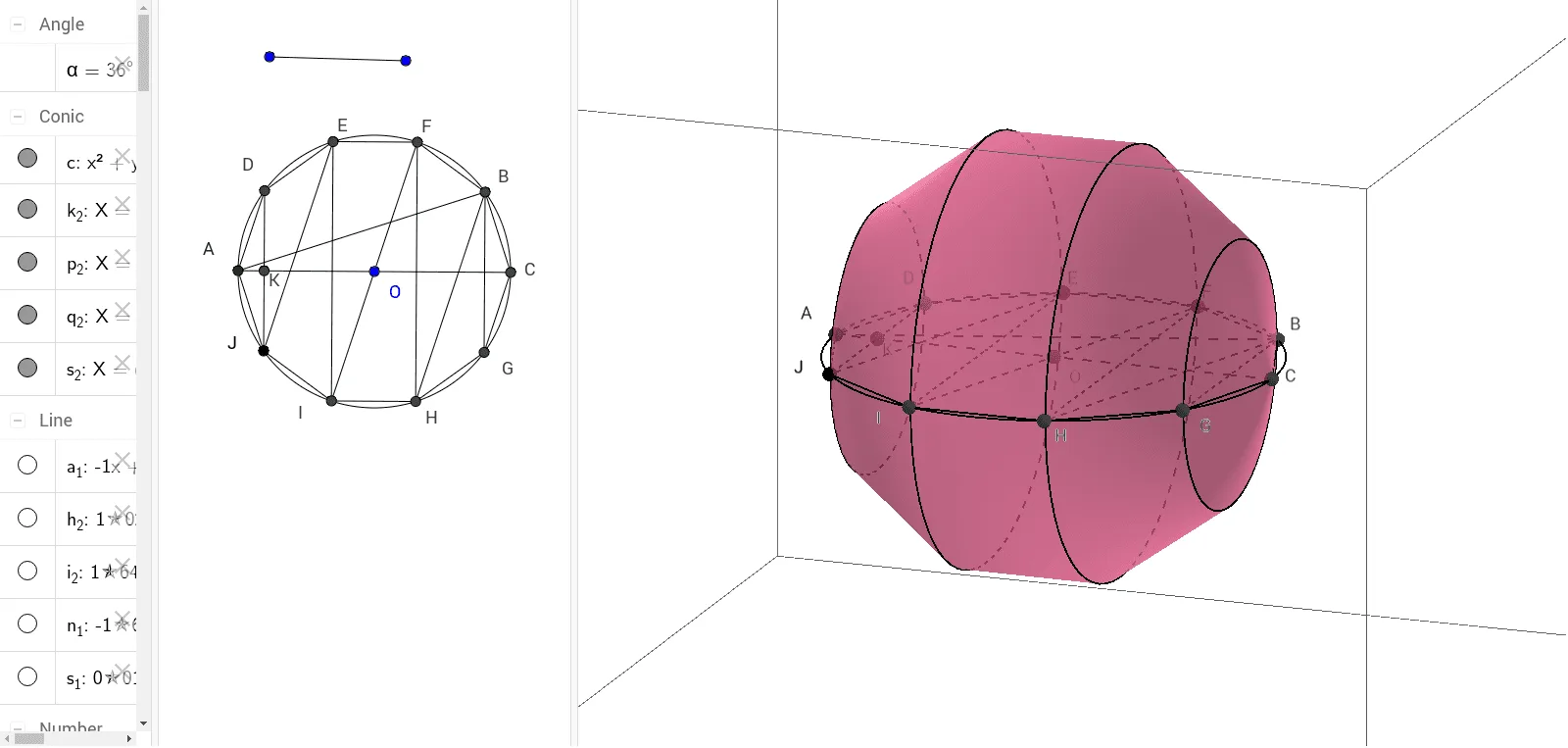
Archimedes Surface Area of a Sphere Diagram
Loading the math board and drawing, please wait…
This example demonstrates Archimedes' diagram for the surface area of a sphere. Key mathematical concepts include spheres, area, and rotation. Using GeoGebra commands such as Segment, Circle, Point, Rotate, and Polygon, a dynamic surface area diagram of a sphere is constructed. Suitable for high school mathematics education and learning solid geometry.
GeoGebra Commands & Parameters
Segment(A_1, B_1) → aCircle(O, a) → cPoint(c) → ARotate(A, α, O) → JPolygon(A, J, n) → poly1, b, l, I, H, G, C, B, F, E, D, d, e, f, g, h, i, j, kSegment(A, D) → mSegment(D, E) → pSegment(E, F) → qSegment(F, B) → rSegment(B, C) → sSegment(C, G) → tSegment(G, H) → a_3Segment(H, I) → b_1Segment(I, J) → c_1Segment(J, A) → d_1Segment(A, C) → e_1Segment(J, D) → f_1Segment(I, E) → g_1Segment(H, F) → h_1Segment(G, B) → i_1Segment(H, B) → j_1Segment(I, F) → k_1Segment(J, E) → l_1Segment(A, B) → m_1Intersect(e_1, f_1) → KIntersect(e_1, l_1) → LIntersect(e_1, g_1) → MIntersect(e_1, h_1) → NIntersect(e_1, j_1) → PIntersect(e_1, i_1) → QDistance(K, D) → distanceKDDistance(M, E) → distanceMEDistance(N, F) → distanceNFDistance(Q, B) → distanceQBDistance(A, K) → distanceAKDistance(L, M) → distanceLMDistance(O, N) → distanceONDistance(P, Q) → distancePQIntersect(e_1, h_1) → RDistance(A, D) → distanceADDistance(A, B) → distanceABSegment(D, K) → r_1Segment(K, J) → p_1Segment(I, M) → q_1Segment(M, E) → r_2Segment(F, N) → r_3Segment(N, H) → t_1Segment(G, Q) → a_4Segment(Q, B) → r_4Segment(A, K) → a_11Segment(K, L) → a_2Segment(L, M) → b_2Segment(M, O) → c_2Segment(O, N) → d_2Segment(N, P) → e_2Segment(P, Q) → f_2Segment(Q, C) → g_2Line(H, G) → a_1Line(G, C) → n_1Line(I, H) → s_1Surface(t, (a_1(t) * cos(u)), (a_1(t) * sin(u)), t, x(H), x(G), u, 0, (2 * π)) → wSurface(t, (s_1(t) * cos(u)), (s_1(t) * sin(u)), t, x(I), x(H), u, 0, (2 * π)) → u_1Surface(t, (n_1(t) * cos(u)), (n_1(t) * sin(u)), t, x(G), x(C), u, 0, (2 * π)) → o_1Line(J, I) → h_2Surface(t, (h_2(t) * cos(u)), (h_2(t) * sin(u)), t, x(J), x(I), u, 0, (2 * π)) → v_1Line(A, J) → i_2Surface(t, (i_2(t) * cos(u)), (i_2(t) * sin(u)), t, x(A), x(J), u, 0, (2 * π)) → w_1Circle(K, distanceKD, y = y(K)) → k_2Circle(M, distanceME, y = y(M)) → p_2Circle(N, distanceNF, y = y(N)) → q_2Circle(Q, distanceQB, y = y(Q)) → s_2