
Geometric Proof Activity for the Multiplication Rule
Loading the math board and drawing, please wait…
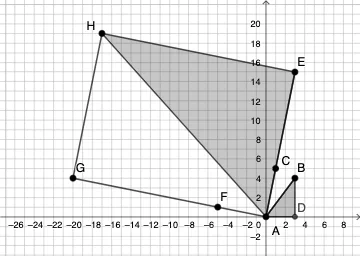
This GeoGebra example uses geometric construction and transformations to visually demonstrate how a multiplication rule (and related product/division relationships) can be supported by a geometric decomposition and correspondence. It centers on geometric construction methods—especially similarity/proportional reasoning that underlies algebraic rules—and on representing quantity relationships with structured, step-like behavior through function-like objects. Construction highlights drawn from the provided command summary include: creating key segments and regions with Segment and Polygon; using Vector together with Translate for directional placement and alignment; applying Rotate and Dilate to build rotational and scaling mappings that preserve the needed proportions; and leveraging solid-geometry-style components (e.g., Archimedean/prism/pyramid elements) to provide clear visual analogues of the algebraic relationships. The scene involves objects such as points A,B,C,D,E,F,G,H, auxiliary variables (a,b,d,e,i,j), vector u, and function-like elements f,g,h as well as t1/t2 and related parameters (a_1,a_2,b_1,h_1, etc.) to tie the geometric configuration to the multiplication-rule statement. Suitable for advanced middle school, high school, and early university activities focused on geometry-to-algebra proofs, interactive demonstrations, and visual reasoning.
GeoGebra Commands & Parameters
Segment(A, B) → fSegment(A, C) → gDilate(C, a, A) → ESegment(C, E) → hRotate(C, 90°, A) → FDilate(F, b, A) → GVector(A, G) → uTranslate(E, u) → HPolygon(A, D, B) → t1, b_1, a_1, dPolygon(A, E, H) → t2, h_1, a_2, eSegment(A, G) → iSegment(G, H) → j
AI Drawing Prompt Reference
Draw a geometry-based proof scene for a multiplication rule. Mark points A, B, and C, then construct the segment from A to B and the segment from A to C. Using A as the reference, scale C to a new point E so that E matches C under the chosen proportion, then connect C to E. Rotate C by 90 degrees around A to obtain point F and then scale F to another point G using a second proportion. Create the segment from A to G and from G to H, define a direction from A toward G, and translate point E along that direction to place H. Finally, form two polygons: one with vertices A, D, B and another with vertices A, E, H, arranged to visually correspond.
The prompt above was compiled from the original drawing commands and is for reference only.